
 Dennis Yu — November 11, 2016 Follow @dennisyu
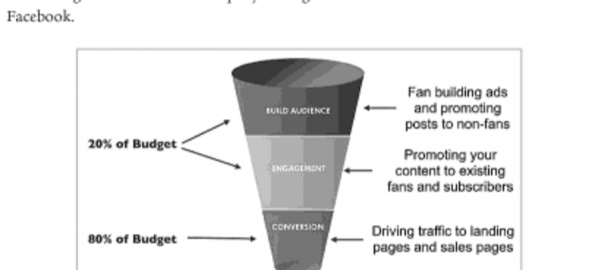
In the Ultimate Guide to Facebook Advertising, Perry Marshall and Keith Kraance demonstrate the typical funnel, wide at the top and narrow at the bottom:

The three layers (audience > engagement > conversion) allow you to cast a wide net, so then you can conceivably lead people down a path of engagement and remarketing.
And it would appear that Facebook agrees with this approach, as you can see in their training:

Facebook even pushes this further. When you create a new campaign in Facebook, you start by choosing an objective within this three-layer funnel:

But what these last two images don’t show you is that the funnel is actually NARROWEST at the top and WIDEST at the bottom.
It should actually look like a cone. In this article you’ll understand why you need to “flip your funnel” (a term I’m stealing from our friend Neil Patel) to get Facebook ads to work properly for you.
Here’s how the funnel should really look:

Admittedly we’ve been preaching the standard funnel for a long time, so we’re embarrassed to admit that the old ways aren’t as effective anymore.
Social proof is your true converter. Boosting posts only requires a dollar a day. A micro-budgets targeted to a micro-audience, and then oCPM does the work for you.
Use small saved audiences to build awareness, custom audiences to drive engagement, and lookalikes to achieve conversions.
AUDIENCE
We used to be vehemently opposed to boosting posts.
It was the joke of social media marketing– a technique only for noobs, certainly not us pros that use Power Editor.
But then Facebook let us boost against custom audiences and various combos of saved target audiences.
And that let us execute the Dollar a Day strategy with ease. And we do mean ease, 80% of our work we could do right in the timeline, never having to go to the Ads Manager or Power Editor.
You can literally select the post, the pre-made audience, and the budget, all right from your page.
Then navigate down the newsfeed, taking 20 seconds for each boost.
It’s so easy and effective that we demonstrate how to boost posts live at conferences.
Set aside your fear and give it a try.
There are 6 amazing things you can accomplish boosting posts:
- Influencing the media
- Surprising and delighting friends
- Fighting back when the big company abuses you
- Growing your client/customer base
- Getting more speaking opportunities
- Growing your personal brand
Each boosted post spends a dollar a day targeting narrow audiences consisting of only a few hundred people.
You might even accumulate 20 or 30 of these minions to do your bidding, stacking up more and more dollar a day posts running evergreen.
The strategy behind this is that people trust their peers more than they trust anything you have to say.
So you’re amplifying (advertising, in layman’s terms) what influencers in your industry and clients have to say, anything but what’s on your site.
Call it old-fashioned word-of-mouth but with a social media advertising twist to scale it.
ENGAGEMENT
You learned in your undergraduate marketing class that the average buyer must be exposed to your message 7 times before they even notice it.
84.7% of statistics are made up, anyway.
The point of “inception” in the above audience building phase is to implant the seed of trust. That way, when they see your next piece of content, they have a fuzzy familiarity with it.
So of course then they will click.
- If they click on a link to your website, they become part of a website custom audience you can remarket to.
- If they like, share, or comment on your post, they become part of a post engagement custom audience which you can remarket to.
- If they watch your video for more than 3 seconds, they are now in your video view custom audience.
- If they click “learn more” in your Facebook lead ad, they can give you their contact information in an auto-filled form.
- If they install your app, you have them as a user and can ask for their email, too, among other things.
- If they check into your retail store, they can be a check-in audience.
Whatever they do, you can reach them with the next message in your sequence, that’s remarketing.
But most people think remarketing is just those dumb ads that incessantly follow you around the web after you leave an e-commerce site.
Marketers are unaware that you can use Facebook’s ridiculously good database to remarket cross-channel:
- Find out how many people have been to your site, but aren’t fans, and target exactly them.
- Find out who is a fan, but hasn’t used your app recently.
- Find out who is on your email list, but hasn’t seen your new products.
And so forth… until you have many custom audiences built up to remarket to.
I don’t know what percentage of spend average Facebook marketers dedicate to remarketing, but I’d guess it’s under 10%.
Of course, the “right” number depends on your sales funnel, but I’d say that 30% would be a healthy number.
Also in the engagement category is boosting posts to interest targets and lookalike audiences.
These audiences are far larger than the “inception” targets of the audience phase, so your engagement layer in the funnel has more spend and much larger audiences.
CONVERSION
Most direct marketers proportionately overspend on conversion, we typically see over 85% of budget spent on conversion. We think it should be about 30%.
And like the earlier caveat, every vertical is different. You may face seasonality, and flat out might not have any content funnels (common in B2B and local).
You’re running remarketing campaigns to drive engagement custom audiences into your conversion points, a lead magnet, free trial, tripwire, core offer, upsell, or whatever structure you have in place.
But the workhorse of your conversion campaigns are your lookalike audiences.
Facebook builds lookalikes from the seeds of your custom audiences; so the stronger your custom audiences, the stronger signal you send Facebook in building lookalikes.
Lookalikes can be as small as a million or even as high as 10 million, so don’t let that scare you.

We used to pride ourselves in being thoroughly targeted in our conversion campaigns, to boast of efficiency in reaching the right folks with creepy accuracy.
But in the last year, we found that too small of an audience won’t give the algorithm room to “breathe”, to do the work for us.
For example, we’ve tested with ZERO targeting on campaigns. These campaigns have not only gotten some traction, but many of these ad sets beat out our well-targeted ads.
The system learns when you feed it the right inputs and allow oCPM to do the heavy lifting.
And usually the client or agency messes things up when they meddle, since they inadvertently exclude audiences that would convert.
They also think they understand who the purchaser is, but are often way off.
If you don’t know about oCPM, it’s the default bid type selected when you choose a business objective.
So choose “website conversion”, “lead ad”, or whatever your goal and let Facebook whittle down to exactly the right audience.
Lookalikes are based on the same logic as collaborative filtering, which has made Amazon and Netflix so popular (people who bought A, also bought B).
For every custom audience that’s worth tracking (not every stage in your shopping cart, please, or every single landing page), you’d want to create a lookalike audience.
- Find out who bought product X and might be interested in product Y that you offer.
- Find out who didn’t buy product X, but looks just like people who love product X.
- Find a 3% lookalike audience who looks like product X purchasers minus the 2% lookalike audience.
So your conversion campaigns have the largest audiences of them all, since you have a bunch of custom audiences and the related lookalike audiences (that are a couple million users each). And if it weren’t for oCPM, you’d blow all your money trying to hit everyone, instead of letting the system sub-target and bid for you.
CONCLUSION
Are you now convinced that your funnel needs to be smaller at the top and larger at the bottom?
If not, I hope you are working for one the competitors of our clients.
Just kidding, we hope that you’ve enjoyed the latest in funnel and ad targeting strategy.
While Facebook changing is a constant complaint, what you can glean from this is that they’re moving towards AI.
This means that eventually you’ll just input your goals, content, and targeting into the machine– then it will do the rest.
But until then, you have rebellious teenager (born in 2004) that you must treat just right to get the results you want.
Now you know the 3 types of audiences to create (custom, lookalike, saved) and how to use them in your 3 layer funnel.
Original Post: blitzmetrics.com/idea-facebook-funnel-backwards/
Digital & Social Articles on Business 2 Community(108)