Traditional ABM is no longer enough. You need a strategy that delivers smarter targeting, better orchestration and measurable revenue growth.

In B2B, the account-based strategies that delivered results just a few years ago are now table stakes. In a world where buyers expect authentic, personalized experiences at every touchpoint, static target account lists, surface-level personalization and overreliance on third-party data no longer cut it.
The truth is uncomfortable but necessary: Traditional ABM is becoming a commodity, not because it doesn’t work, but because everyone is doing it. When everyone follows the same playbook, no one stands out.

This doesn’t work in the enterprise. Complexity exists everywhere: multiple buyers, products and solutions, markets and geographies, and direct sales versus partner-led sales motions. It’s too much for basic ABM to handle.
How do you evolve your strategy? It starts with a comprehensive audit of your go-to-market approach to identify the insights that can inform a more sophisticated, dynamic account-based experience (ABX) strategy — one that you can execute to attain net new logos or expand existing accounts. Let’s break down this transformation into three key phases.
Phase 1: Auditing your GTM to find useful signals
Think of your GTM audit like a home renovation. Before ripping out walls or installing new fixtures, you need a thorough inspection to understand how it was built.

Start by gathering every data point prospects and customers create during their interactions with marketing, sales, customer success and operations: campaigns, channels, tactics, content engagement, messaging performance, processes, budgets, market data and buyer journey touchpoints.
With your data assembled, map it to your revenue architecture. Begin with the end in mind: revenue. Slice your revenue data by all available dimensions:
- Source.
- Segment.
- Geography.
- Inbound vs. outbound.
Now you know how and where your revenue gets generated, not where you think it comes from.
Next, associate this data with the entire customer journey to find trends and patterns in how your GTM currently acquires, grows and retains customers. Look at your funnel from both:
- An absolute volume perspective (how many accounts progress through each stage).
- An efficiency lens (conversion rates between stages).
Document your lead flow process, mapping every step from inquiry to revenue. Overlay your existing tools, workflows and systems to identify gaps, redundancies and opportunities for optimization.
The outcome of a thorough GTM audit is a clear blueprint of your current revenue architecture and lead flow. These documents show the entire organization how marketing and sales currently process leads, where the friction points are and which signals predict revenue.
Phase 2: Understanding the modern ABX framework
Modern ABX represents a fundamental shift in how we think about account-based strategies.
- Traditional ABM is often a marketing-driven initiative focused primarily on new customer acquisition.
- Modern ABX is a GTM-wide motion that aligns marketing, sales and customer success around a data-driven taxonomy of accounts, buying groups, segments and marketable audiences.
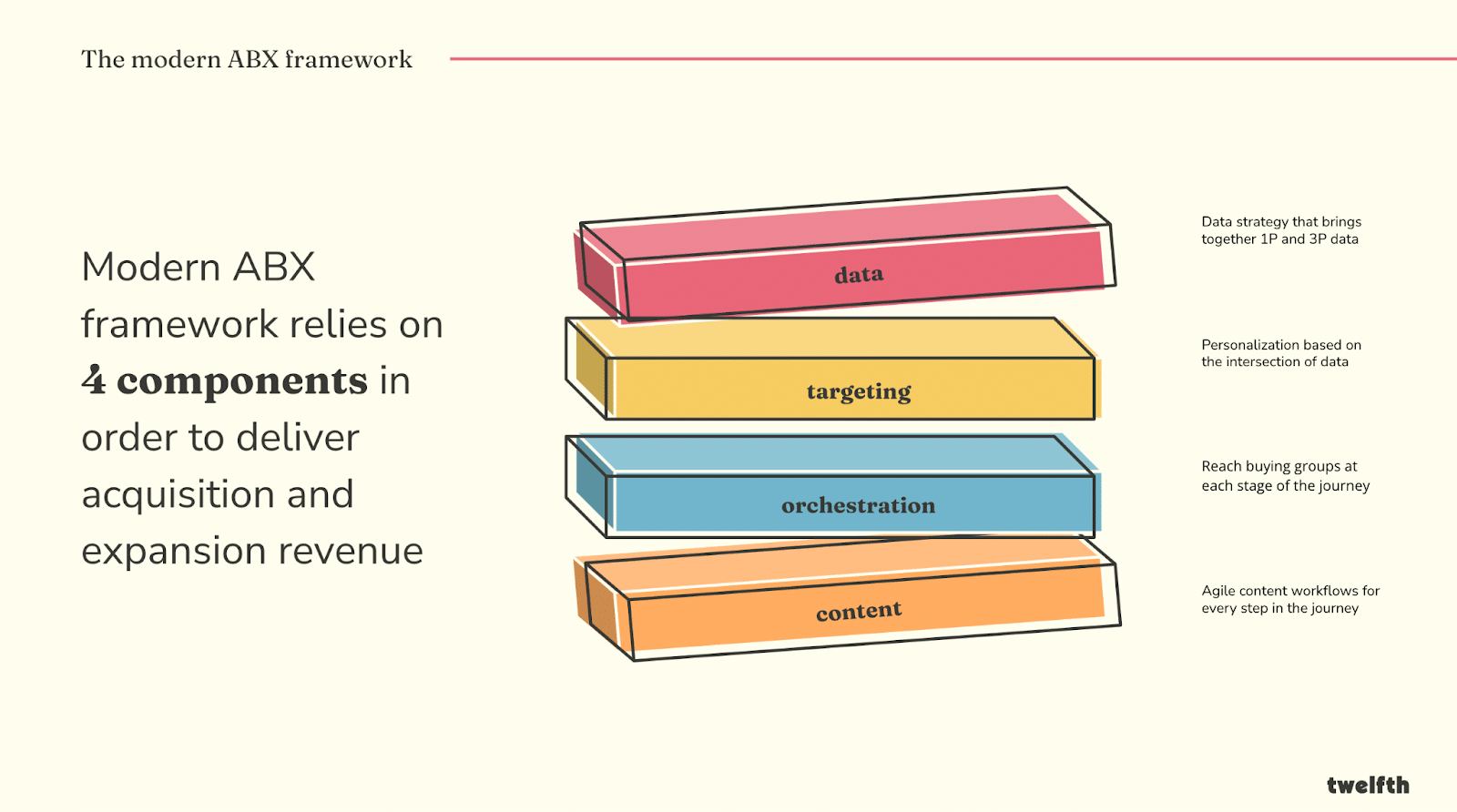
The modern ABX framework consists of four integrated components:
Data
- Integrating first-party and third-party data creates a complete view of accounts and buying groups.
- This isn’t just about having data but about unifying it in ways that enable action, measurement and insight. The data layer is the foundation upon which everything else is built.
Targeting
- Moving beyond static account lists to identify marketable audiences based on multiple signals.
- Here is where the insights from your GTM audit become actionable. You will identify which combination of firmographic, demographic and intent signals predict buying behavior.
Orchestration
- Coordinating multi-channel, multi-threaded engagements across the buyer journey.
- Modern orchestration includes bespoke experiences for different personas within the buying group, aligning marketing and sales activities to create a seamless experience.
Content
- Developing agile content workflows that enable personalization at scale.
- Modern ABX content isn’t about creating an endless library of assets but about using core elements you can assemble dynamically based on audience needs.
At the intersection of these components is the concept of “marketable audiences,” which we pioneered at my agency. These are groups of accounts and contacts showing an observable propensity to engage with marketing based on multiple signals. These audiences are fluid, not static, moving in and out of engagement windows based on their behavior and needs.

The industry wants to see “buying signals,” not “marketable audiences.” Unfortunately, it’s nearly impossible to determine real buying propensity at an enterprise level. What we can determine is whether the person we are marketing will actually respond.
Now that your audit is complete and you understand the modern ABX framework, it’s time to prepare for implementation. This requires operational changes across your marketing and sales processes.
Phase 3: Preparing to implement modern ABX
Start with account planning
Develop a systematic approach to:
- Define your account universe.
- Enrich account data.
- Map buying groups.
- Integrate first-party data.
- Enrich with third-party data.
- Establish account tiering methodology.
These are the foundation for everything that follows.
Reimagine your segmentation strategy
Segmentation based solely on firmographics or technographics won’t deliver the personalization modern buyers expect. Instead, look for the sweet spot where multiple data points intersect to create marketable propensity.
Design your orchestration process
Create an agile planning, execution and testing cycle for marketing and sales to identify, engage and qualify in-market accounts, then rinse and repeat. Doing this requires multi-channel, multi-threaded coordination across buying groups.
Transform your content approach
In the age of AI, content creation is shifting from producing individual assets to using human creativity to develop core stories and ideas that can be used in different styles, formats and topics.
Shift from traditional funnel metrics to account-focused engagement metrics
Track which accounts are showing signs of propensity, measure individual contact engagement across personas and evaluate campaigns on both absolute revenue and efficiency.

The path forward
Traditional ABM isn’t dead; it’s evolving. Companies seeing extraordinary results today are embracing a sophisticated, dynamic approach using the full power of their data, technology and people.
Thoroughly auditing your GTM, understanding the modern ABX framework and preparing your organization for strategic implementation can transform your account-based strategy. It will take it from a static targeting exercise to one that drives measurable revenue growth.
The future of B2B is in identifying and engaging the right accounts with the right message at the right time continuously throughout the customer lifecycle.
The post Why modern ABX is the future of enterprise GTM appeared first on MarTech.
About the author

Steve is currently the CEO & founder at twelfth, a boutique marketing agency that specializes in GTM growth and demand generation. Prior to founding twelfth, Steve held several marketing leadership positions in the B2B SaaS industry including Google Cloud, Workspace, Chrome, and Android. Steve is a keynote speaker, frequent podcast guest, and thought leader on the topics of account-based strategies, GTM, demand generation, growth marketing, and operations.
(11)