Great emails don’t happen by accident. Follow this six-step process to write messages that connect, persuade and convert.

How many unread emails are sitting in your inbox right now? I have 10 in one inbox, 23 in another and about 98 in my personal one — and all of them stress me out. The average American, by the way, has more than 1,000 unread emails. Yikes.
Still, as cluttered as your inbox may be, you do read emails. Some make you think or feel something. Every now and then, one even makes you click. How do you send more of those emails?
How an effective email actually works
The relationship between the subject line, preview and body looks like this:
- Contrary to popular opinion, your subject line isn’t just about grabbing attention — it’s about relevance. Relevant, timely messages get opened. Irrelevant ones get ignored.
- Your preview text (or the first line of your email, if you’re sending cold campaigns) should reinforce that relevance and timeliness.
- Finally, your email body should deliver on the promise of the subject line and preview text with a clear, compelling message that leads naturally to your call to action.
Simple enough, right? Now let’s actually write the email.
Step 1: Clarify the objective
Every email you send should have one objective. It should get your readers to book a meeting, register for a webinar, watch a video or listen to a podcast. In other words, what are people reading this email supposed to do or feel?
Whatever your objective, every part of your email — from the subject line to the P.S. — needs to support it. Be clear on this before anything else.
Newsletters can include all of these actions and more, but even your newsletter should have one ultimate objective. For most companies, that objective is relationship-building.
Step 2: Clarify the key and supporting performance metrics
Once you’ve set your objective, decide how you’ll measure success. Unique opens? CTR? CTOR? Replies? Unsubscribes, even? (List hygiene is important — not all unsubscribes are bad.)
Step 3: Prepare the brief
You should have an email-specific brief, just like you would for any other channel. Ideally, it should serve two functions: operations and messaging.
Operations covers the campaign logistics, namely:
- Lists.
- Segments of the lists.
- Target personas.
- Call to action.
- Links.
- Assets/resources (images, GIFs, video, etc.).
- Sender name and email.
- Where KPIs will be found.
Messaging is how you prime readers for your objective. What do they need to think and feel to act? The messaging part should include:
- Your unique mechanism or solution.
- Claims and promises.
- Background story.
- Testimonials, reviews or case studies.
- Scarcity elements, angles and hooks.
- Subject lines.
- Preview text.
You won’t use every part of the brief, and that’s fine. Its purpose is to outline your email and structure your message.
Step 4: Outline your email
Now we get to the writing part. When done well, a solid brief will more or less outline your email for you. I usually start by choosing a copywriting structure based on the message and objective of the email.
If the message targets a pain or struggle, I’ll use frameworks like pain, agitate, solution (PAS) or attention, interest, desire, action (AIDA). If I’m speaking to an aspiration or mindset shift, I’ll use desire, obstacle, solution (DOS) or picture, promise, prove, push (PPPP).
I often begin by taking the messaging elements from my brief and dropping them into a basic outline in a Google Doc — subject line, preview text, body copy and so on. From there, I rearrange or refine as needed.
Step 5: Draft the email
Depending on how well trained your LLM is, you can use AI for this step too. But drafting is where you add flesh to the bones of your structure.
The stronger your structure — and the more assets, stories and testimonials you have — the easier this part becomes.
Step 6: Edit your email
This is the most important (and often the most underrated) step in the writing process. As Ryan Law says, “editing is the process of improving the performance of written content.”
This is where you audit and refine your copy to ensure it’s primed to accomplish your objective. Review your email and ask yourself:
- Does it support the objective?
- Does it evoke the right emotion or make a compelling argument?
- Does it back that emotion or argument with the right stories or proof?
- Is the CTA congruent with the copy and the step we want readers to take? (If people are expecting pricing, show them pricing. If they’re expecting a webinar registration form, show them the form.)
When you do this well, you get an email like this:
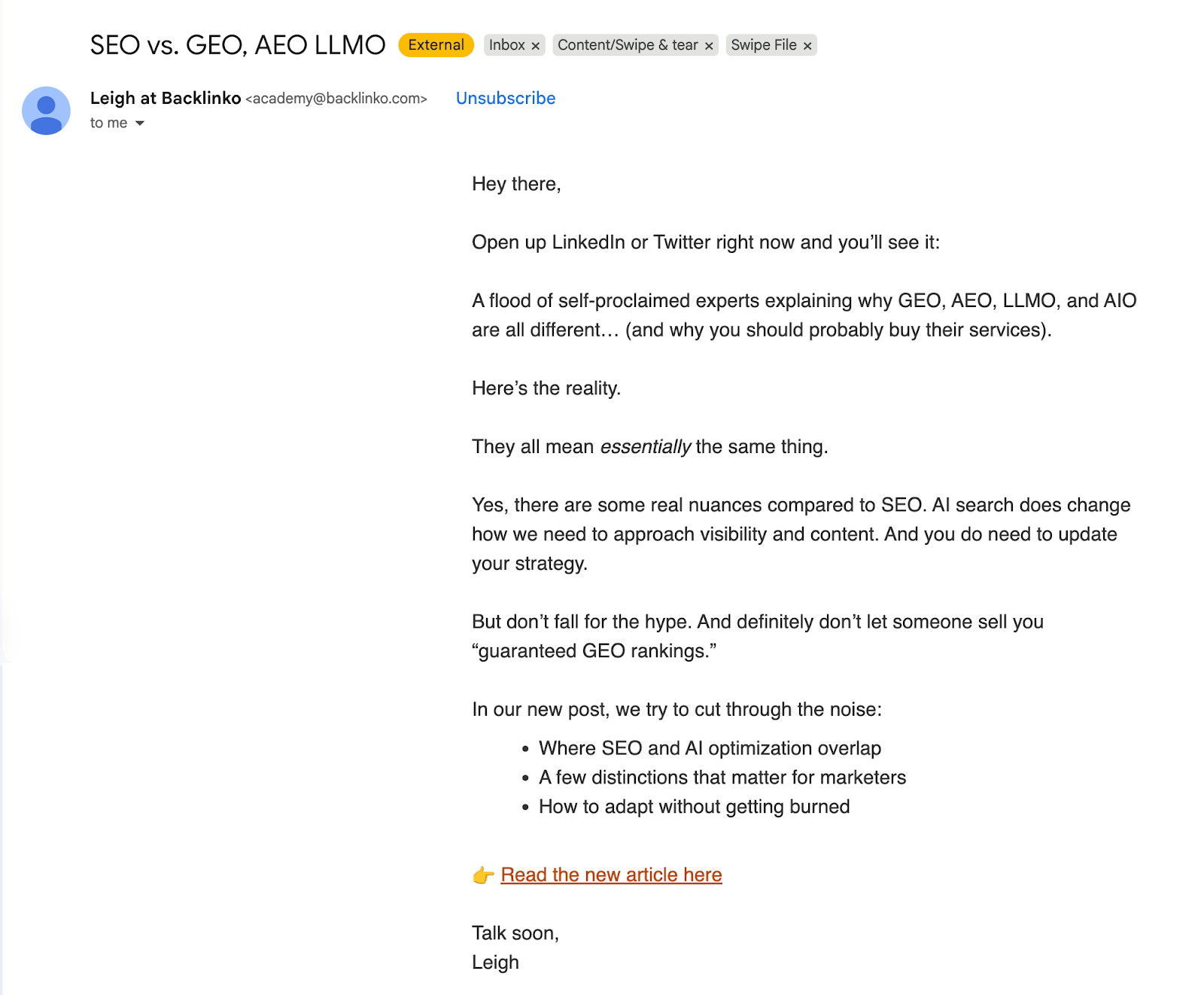
The subject line demonstrates relevance and timeliness by leading with a topic many marketers are thinking about and trying to navigate. The opening line builds on the subject line without repeating it and sets up the body beautifully. The body itself addresses a real challenge, promises clarity and closes with a congruent, compelling call to action.
It looks simple — but meaningful emails like this only happen with a solid copywriting process. Kind of like the one above. Try it out and see how it goes.
The post 6 steps to writing emails that get opened and acted on appeared first on MarTech.
About the author

Joe Cunningham is a conversion copywriter, editor, and AI messaging strategist. He’s the managing editor of the digital marketing newsletter Stacked Marketer, and founder of AnthroHub, the agency for companies using Singulate to personalize their email marketing messages. He has written email and ad campaigns for numerous 6+ figure brands including Affiliate Summit, Huel, and others.
(7)