A new term has slowly been gaining traction on social media. Will it last?
Almost two years ago, the Berlin-based artist Boris Eldagsen made the headlines after winning the prestigious Sony World Photography Award with an AI-generated image, then rejecting the award. “AI is not photography. Therefore I will not accept the award,” he wrote on his website. In a separate statement made a week later, he added an important question: “But what is it?”
When AI image-generation programs like Midjourney and DALL-E went mainstream, people making images using AI jumped to the closest associations they had: “AI photography” or “AI-generated art.” But making an image using AI is a different process that deserves a different word. Eldagsen’s suggestion? “Promptography.”
Over the past few years, the word “promptography” has been slowly gaining traction. The hashtag #promptography has been used more than 80,000 times on Instagram. An increasing number of artists are now using it to tag images they make using AI. Some, like Montreal-based artist Stefanie Lefebvre or the Swedish artist Annika Nordenskiöld are even calling themselves “promptographers” on their Instagram bios. Here, we unpack the growing trend.
What’s in a name?
Peruvian photographer Christian Vince first coined the word “promptography” in a Facebook post following Eldagsen’s resignation from the Sony Award. As Vince recalls it, Eldagsen then reached out and asked him for permission to borrow the term. “I think it’s an appropriate term to define photorealistic images created with prompts,” says Vince.
Eldagsen, who studied philosophy on top of visual arts, told me that some objects and processes need proper terminology in order to enable discussion, so he was thrilled when Vince put forward “promptography.” Some artists have been using “syntography” to describe images generated with AI, but Eldagsen says the word is too redolent of the synthetic clothes he wore in the ‘70s for it to resonate. “‘Promptography’ is clear, because everything that is generated needs to start with a prompt because AI has no intentionality, AI has no will,” he says.
The reason promptography works so well, in his opinion, is because it so clearly describes the process. While photography involves a person venturing out into the world, pointing a camera, and capturing a real moment in time, an AI image involves a person sitting in front of a computer, shaping words into images. The “act of pointing,” once described by John Szarkowski, a former director of photography at New York’s Museum of Modern Art, has become the act of prompting. And by describing AI-generated images as “promptographs,” we are telling people the difference. “You wouldn’t call a photorealistic painting photography,” he says. “Apples are not potatoes.”
According to Belgian film director Francois Mercier, who goes by the nickname Mr. Francois, the dissonance goes all the way back to the etymology of the word. If we break it down, the word “photography” comes from the Greek words photós (meaning “light”) and graphê (meaning “drawing or writing”). The word literally translates to “drawing with light,” and as Mercier points out: “That doesn’t quite fit AI-generated images, does it?”

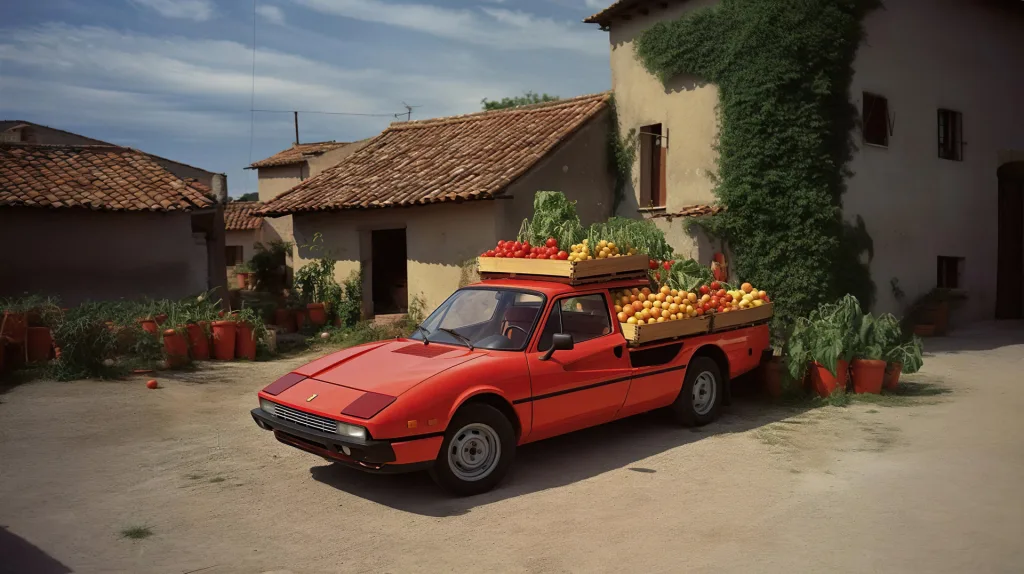
Mercier recently published a book of 300 promptographs—that’s the word he used. In the book, titled Secret Cars, he used Midjourney to imagine alternate realities in which Lamborghini makes a school bus, or Ferrari makes a motor home. He says the word “promptography” reflects the way people make images using AI: not with light, but with a prompt. “Prompting is the craft,” he says.

A misunderstood process in need of a rebrand?
The problem is, many people don’t consider generating images using AI as craft, and a word like “AI-generated photography” doesn’t sound very alluring. Aside from being inaccurate, it is clunky, undignified, and it completely removes the human from the equation. Could a new label help elevate the craft?
According to artist Marcus Wallinder, whose once peppy, now dark and surreal style has been profoundly reshaped by AI, the word “promptography” gives the process “a sense of intentionality and artistry, which helps to differentiate it from the idea that AI-generated images are effortless.”
On top of the knowledge required to describe styles or art movements, artists working with AI often spend hours crafting, iterating, and fine-tuning their prompts, and sometimes hours more editing and polishing the final image. Eldagsen likens the process to that of a mixologist creating an advanced cocktail. Pentagram partner and author of Artificial Typography, Andrea Trabucco-Campos, likened it to that of an art director or a curator.
For Wallinder, the process is “akin to being the set designer, lighting technician, costume designer, makeup artist, props master, and stylist—all rolled into one,” he says. “While AI brings unpredictability, it’s my responsibility to shape that unpredictability into a cohesive and compelling vision.”
Only time will tell whether the word will actually stick or if the majority of artists will continue using other catch-all terms. For those who remain opposed to AI, the word might not matter. As one artist put it on Instagram: “A Promptographer is someone that pretends to be a photographer, while knowing nothing about photography or its principles, but instead uses AI to do all of the work and takes all of the credit.”
Maybe the word “promptographer” is too close to the word “photographer” and the proximity, too insulting. But the rise of “promptographer” does seem to reflect a growing acceptance of AI as “a legitimate artistic tool,” as Wallinder puts it. The ultimate test, I suppose, will be if the word ever makes it into the Oxford English Dictionary.
(33)