
 Allie Decker — March 10, 2018
 — March 10, 2018
Influencer marketing is an incredibly lucrative industry – and powerful marketing move for brands. Businesses, especially those new to Instagram and marketing on social media, should consider running an endorsed or sponsored Instagram post from time to time.
Working with influencers gives your brand a face and personality outside of native marketing efforts and introduces your product to a broader, fresher audience. It’s a more-than-justified addition to your marketing budget.
But with a rise in influencer partnerships and endorsements has come an increased interest by the Federal Trade Commission (FTC). In fact, they’ve kept a much closer eye on endorsement and influencer activity over the last year than in the past.
In April 2017 alone, the FTC sent over 90 warning letters to influencers that were violating their rules about endorsing and advertising products. (And that’s just one month’s worth of activity.)
But, though influencers have been the recipients of warning letters, both the influencer and brand have responsibilities to the FTC and consumers to provide clear and accurate sponsored content.
So, how can your brand run sponsored Instagram posts without getting slapped by the FTC? What are the specific rules? Is posting #ad in the caption enough? How can you navigate sponsored Instagram stories? Read on to find out.
What is the Federal Trade Commission?
The Federal Trade Commission (FTC) is a consumer protection agency that works to prevent fraudulent or deceptive advertising and to educate “marketers about their responsibilities under truth-in-advertising laws and standards.”
Only recently did the FTC start cracking down on endorsements and advertisements on social media, though.
In 2009, the FTC issued an updated guide that covers endorsements and testimonials in social media advertising. They also published an FAQ of sorts to help both influencers and brands post sponsored posts responsibly.
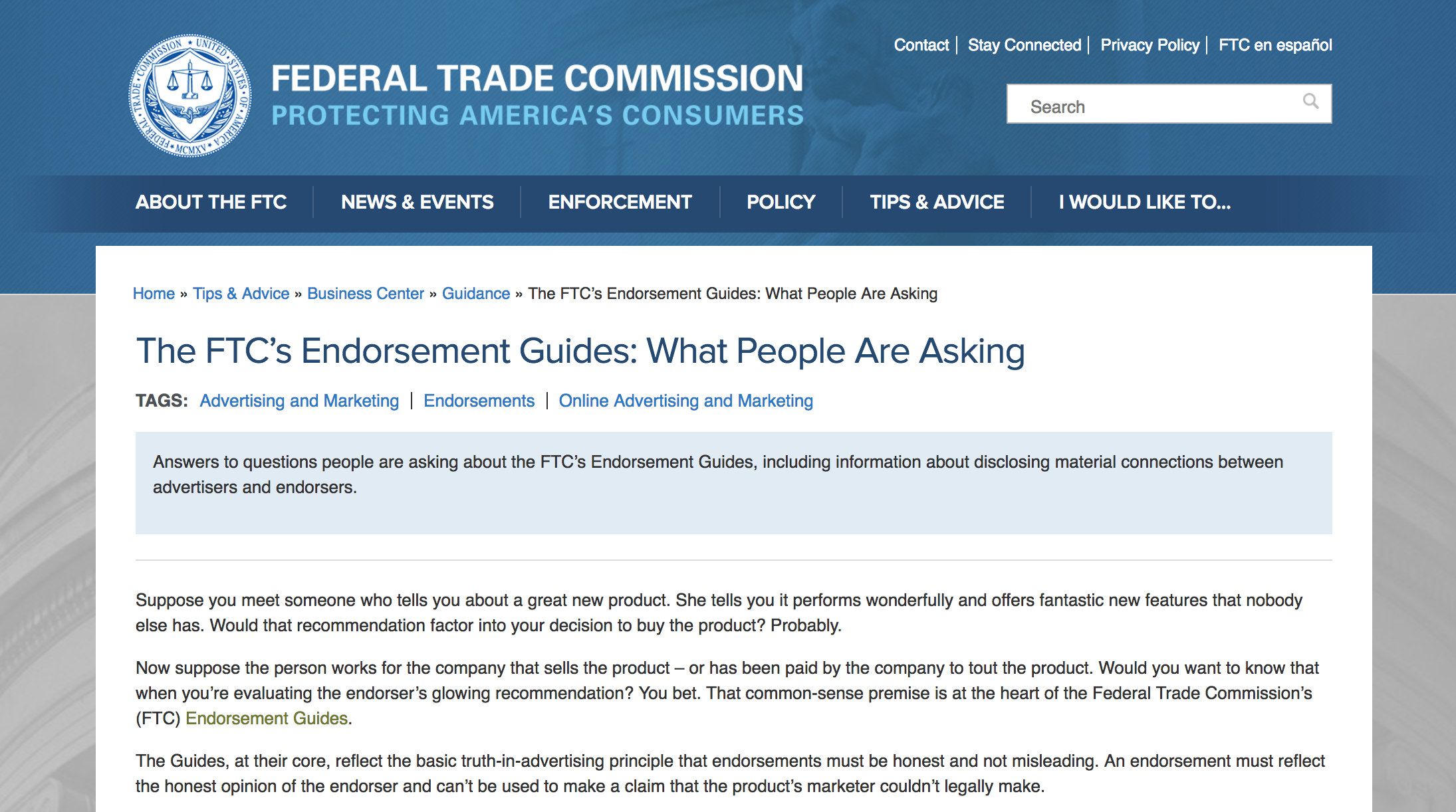
That’s a lot of legal jargon to read, isn’t it? That’s why we’re going to break it down for you below.
Remember, if you want your brand to be successful and safe on Instagram, you must follow the FTC’s rules. Start here.
How to Run a Sponsored Instagram Post and Keep the FTC Happy
The first question many businesses ask is when to disclose sponsorship in each post.
According to the FTC’s updated guide published in 2009: “When there exists a connection between the endorser and the seller of the advertised product that might materially affect the weight or credibility of the endorsement (i.e., the connection is not reasonably expected by the audience), such connection must be fully disclosed.”
Hmm, what does that all mean?
- Connection – Forms when your brand pays, trades services with, gives a gift to or establishes a professional or personal relationship with an endorser.
- Endorser – The influencer or individual who’s posting about your brand.
- Disclosure – Telling your audience that you have a connection outside of a business/consumer relationship. (We’ll expand on the different types of disclosure below.)
So, why does the FTC require disclosure? It’s simple: To be transparent consumers. The purpose of the disclosure is to separate a paid endorsement from an earnest “Hey, I like this!” post.
In short, if your followers can’t tell right away that your influencers have a connection to your brand, you’re probably violating the FTC’s rules. It’s just as much your responsibility as a business to follow the FTC guidelines as your influencers’ and partners’.
In fact, most brands establish their own partnership rules (which we’ll discuss below). Basically, you need to be on the same page with your influencers to ensure that both parties are compliant.
Let’s break down exactly how you can disclose a sponsored Instagram post and keep the FTC happy.
How to Disclose Sponsored Instagram Posts
There are a few different ways to communicate a partnership through a sponsored or endorsed Instagram post. To comply with the FTC guidelines, make sure you encourage your influencers to follow (at least) one of these methods.
With a Hashtag
It’s been common practice for influencers to disclose an Instagram sponsored post by placing #sponsored, #spon, #ad, #paid, #partnership or a similar hashtag in their caption.
Well, that doesn’t count as disclosure to the FTC. The only fully compliant hashtags for sponsored Instagram posts are #ad or #sponsored.
According to the FTC, “…avoid ambiguous disclosures like #thanks, #collab, #sp, #spon, or #ambassador. Clarity counts. When disclosing a material connection to a brand, use language that’s clear and unmistakable. It’s unlikely that abbreviations, shorthand, or arcane lingo will communicate the disclosure effectively to consumers.”
Also, the FTC asks that influences place these hashtags where consumers can see them, meaning you can no longer bury them in the middle or at the very bottom of a caption. Instagram captions cut off after 3 to 4 lines, and consumers don’t always click the “…more” to expand the text.
“Consider your own viewing habits on social media. Do you click every CLICK MORE link? We don’t either. When disclosing a brand relationship, the better approach is to hit ‘em right between the eyes,” says the FTC.
Lastly, don’t hide your hashtag in the middle of another, such as #adbySchedugram or #sponsoredbySchedugram.
Without a Hashtag
Although we always encourage the use of hashtags (they can increase your engagement by 70%!), there may be an instance or two where your influencers choose to leave them out of a caption.
Good news: You can still disclose without a hashtag, but you still need to make it very clear that the post is an endorsement.
Here are a few good examples of disclosures sans hashtag:
- “Thanks to @adidas for sponsoring today’s run!”
- “Shoutout to @fashionnova for gifting me these awesome jeans.”
- “Check out this awesome water bottle that @swell sent me!”
Remember, the goal is transparency. If your audience can’t tell the difference between a paid endorsement and an earnest “Hey, I like this!” post from the caption, you’re likely not disclosing correctly.
Through a Brand Partnership Mention
I mentioned above that many brands create their own hashtags and partnership campaigns in which their influencers can participate. You can do this, too.
Creating your brand’s own endorsement hashtag is a good idea for a couple of reasons. It establishes another branded hashtag with which your business can be associated and separates your hashtagged posts from the millions of sponsored posts.
It’s also beneficial for your influencers as a branded hashtag may sound more natural in a caption than #sponsored or #ad.
For example, Airbnb created a brand partnership hashtag for their influencers and asks them to place it at the beginning of every caption. See how they use #airbnb_partner:
If you choose this route, be sure you include your brand name AND partner when asking your influencers to participate. Only those hashtags count as compliant.
Through Instagram’s Paid Partnership Feature
In June 2017, Instagram released a native tool for disclosing sponsored posts.
When an influencer is paid or gifted by a brand, the feature allows them to tag the brand in the top of the post (where the location tag typically is).

This tool is an effort made by Instagram to create more transparent paid partnerships and endorsements, but Instagram doesn’t yet require brands and influencers to use it.
On the brand side, the feature is available to Business Profiles – although there’s no rhyme or reason to who can access it.
Chances are that larger, verified brands can tap into it and invite their influencers to use it. (So, if you’re using a Business Profile and don’t see the Branded Content option under Advanced Settings when posting content, you’re likely not connected yet.)
While this new tool is a convenient reminder tool for influencers and brands marketing on Instagram, the FTC says that disclosure shouldn’t stop there.
“Don’t assume that using a platform’s disclosure tool is sufficient,” the FTC says. “One key consideration is placement – whether the disclosure attracts viewers’ attention, taking into account where people are likely to look on a particular platform. The ultimate responsibility for making clear disclosures is yours. That’s why you want to make sure your disclosures are hard to miss.”
If you opt to use Instagram’s Paid Partnership feature, go ahead and pop a few hashtags into your caption, too. When it comes to the FTC’s rules, it’s better to be safe than sorry.
How to Disclose Sponsored Instagram Stories
Many influencers show off their products and partnerships through Instagram Stories, too. From unboxing to testing to reviewing, influencers and endorsers take advantage of Stories to show off their gifts and goodies.
Does that mean influencers need to disclose sponsored Instagram Stories? Yes!
According to the FTC, the disclosure must be visible and posted on every image or video that features an Instagram sponsored post.
“On image-only platforms [like Snapchat or Instagram Stories], superimpose your disclosure over the picture in a clear font that contrasts sharply with the background,” says the FTC.
Because many users watch Instagram Stories without the sound on, it’s important that you visibly mention #sponsored or #ad, not simply say it out loud in your video. Also, make sure your text disclosure is visible throughout your entire Story, even if you’ve already mentioned the hashtags. Again, don’t assume that consumers will detect a sponsored ad.
Does Tagging Count as Disclosure?
We’ve previously discussed how powerful tags can be on Instagram. They can connect your content to new audiences, engage other brands and users, and help your posts land on the Instagram Explore page.
But, is dropping a brand’s tag on an image enough to count as disclosure? Nope. In fact, tagging a brand requires disclosure.
If an influencer has a connection (remember the definition from above!) with a brand and tags them in an Instagram post – even if that post itself isn’t sponsored – the FTC considers that an endorsement, thus requiring disclosure.
For example, if an influencer posted a sponsored post in January featuring some Jeni’s ice cream (…yum), and then posted another unsponsored photo of Jeni’s in February (because it’s just so dang good), the FTC would consider that February photo an endorsement, too.
The reason behind this is because the FTC can’t be certain that every consumer has seen the January sponsored post. (And due to Instagram’s new algorithm, they likely haven’t.)
Essentially, once a brand / influencer relationship is formed, both parties should continue to adhere to the FTC disclosure guidelines, even if every post isn’t sponsored.
Does a Free Gift Require Disclosure?
Free stuff is awesome, isn’t it? And Instagram influencers receive a lot of it. If they choose to post about it, are they required to disclose that the product (or service) was gifted?
Yes, definitely.
According to the FTC, a material connection refers not only to being paid but also receiving free stuff – especially if it’s in exchange for social media exposure.

If an influencers receives a free product with the expectation that they’ll post about it on Instagram, they must disclose.
(Don’t worry – if you grab a free sample from those sweet old women handing out cups of salsa at Costco, you’re not required to disclose it on social. In that case, the only material connection you have with the Costco brand is an uncanny love for shopping in bulk.)
Final Thoughts
This might seem like a lot of information to digest, but the gist is pretty simple: Prioritize transparency for your consumers. If you can’t look at your sponsored Instagram post or Story and immediately understand that it’s a paid endorsement, then it’s not following FTC disclosure guidelines.
Here are a few main points to take away from this post:
- A material connection (in the eyes of the FTC) is when a brand pays, trades services with, gives a gift to, or establishes a professional or personal relationship with an endorser.
- To properly disclose a sponsored Instagram post or Story, post #sponsored or #ad at the beginning of the caption or visibility over your Story image or video.
- Tagging a brand in an Instagram post (even if the post isn’t sponsored) requires disclosure only if the influencer has a prior professional relationship with the brand.
- If you have access, don’t rely on the Instagram Paid Partnership feature to fully comply with FTC guidelines
- It’s just as much a brand’s responsibility to follow FTC guidelines as it is the influencer’s or endorser’s.
When in doubt, disclose! Keep your brand’s Instagram activity safe and successful by complying with FTC guidelines and providing full transparency to your consumers. They’ll thank you for it!
Digital & Social Articles on Business 2 Community
(97)