Slapping together a couple ideas and a logo is not a brand strategy, says contributor Allen Martinez. Here’s a detailed guide to help you create and execute a well thought out strategy to promote your brand.
When it comes to having a brand strategy, it’s not enough to simply have a few bullet points of what you want to do. Brands today need both a thorough understanding of why they choose certain strategies and a detailed outline of what their strategies will be.
Why?
Because the more detailed you are in your branding strategy, the easier it will be to succeed when you execute those strategies.
Here are three things every brand needs to define:
- What is your brand’s objective?
- Who are your customers?
- How does your brand define long-term success?
Knowing the answers to each question will help determine what your goals should be, how you should approach your customers and how you’ll measure your success in meeting your goals.
Creative messaging
As CEO of BBDO, Andrew Robertson mentioned at a 2017 AT&T Shape event, media leaders like Sheryl Sandberg made it clear to him that
“80% of available return is a function of the creative and of the content”
A brand’s success is attributed to having the right creative message and not just being in the “right time” or “right place.”
What does Robertson’s comment mean? It means that your focus shouldn’t be solely on the tech involved; instead, concentrate primarily on story and positioning.
What does focusing 80% of your energy on messaging look like?
Well, for one thing, it doesn’t look like this:
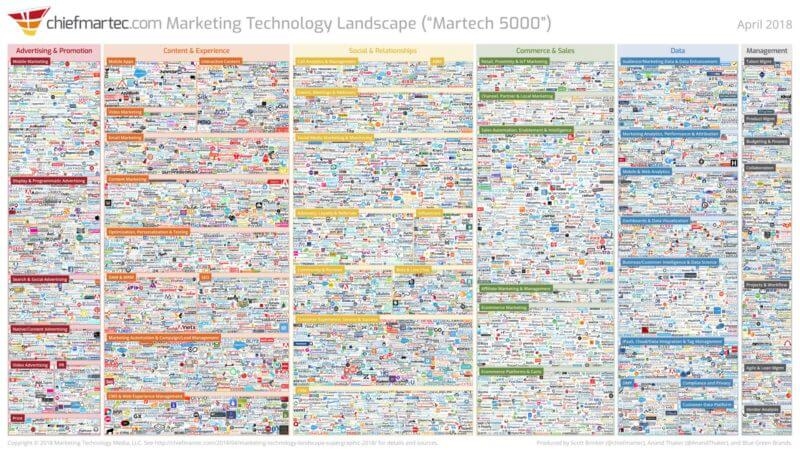
It should look like this:
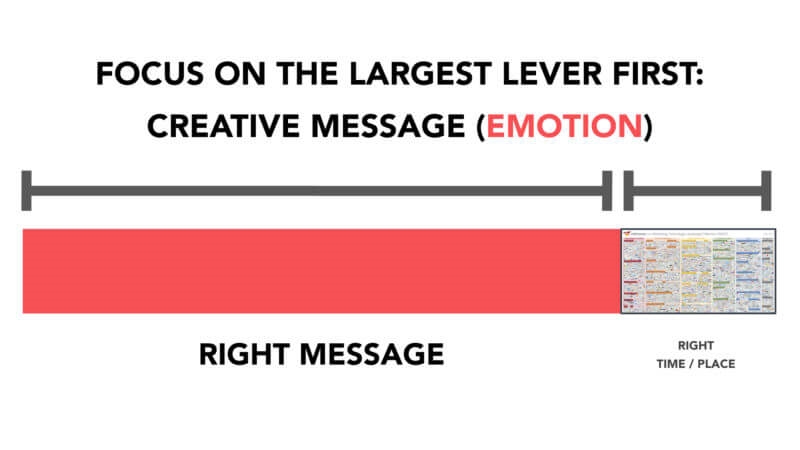
It is important to really understand your strategy first before you focus on the execution of strategy.
What is a brand strategy?
A brand strategy can be hard to define but encompasses:
- What your brand stands for.
- What promises your brand makes to customers.
- What personality your brand conveys through its marketing.
As you can see, many of these things are intangible. How do you measure how successful you are at conveying a certain personality? How do you measure if you’ve successfully stood for what your brand represents, or if you could be doing it better?
The one main metric for successful brand strategy is brand sentiment. And just because it’s hard to measure, it doesn’t mean that you should dismiss it. It may not be as easy to quantify, but it’s too easy for analytical CEOs to dismiss the qualitative work involved in branding. As Airbnb CEO Brian Chesky made so clear:
The designing of experience is a different part of your brain than the scaling [of] your experience. It’s a different skill set. The scaling experience is a highly analytical, operations-oriented, and technology-oriented problem. The designing of experience is a more intuition-based human, empathetic, end-to-end experience.
It seems almost trivial, but in a larger company, these two different skill sets would be handled by two entirely different teams that probably don’t often commingle, let alone agree on everything. That’s how you waste time, money and energy. In a small startup, you might be missing a “creative” angle altogether.
Does this resonate? Some see branding as fluffy, touchy-feely emotional stuff. But that’s a superficial way to describe it. Branding is critical to your brand’s existence! It also feeds your entire team’s culture. Let’s dive into this skill set.
Developing intuition
Branding strategy definitely involves the intuition side of your mind. But you can also use data to guide your direction. One way to understand if your brand is on the right track in its branding strategy is to think of your brand strategy as a story you are telling.
A good story is not just something to read on a page — it’s an experience. And for something to be an experience, it needs to have a beginning, a middle and an end. At the end of the experience, there must be some kind of change from the beginning.
What causes a change in a story? Tension. There must be tension between your antithesis and your thesis.
In marketing terms, your “antithesis” is your customer’s pain point. Your “thesis” is your solution to that problem. The tension, therefore, is the customer’s problem itself. This is the core of your entire product-market fit, viewed at a subatomic level. If you don’t have any tension there (problems to solve), then you don’t have a business, period!
So, at the end of the day, brand strategy boils down to one thing: storytelling. Your brand’s strategy is its story, its vision, its heart and soul.
For example:
Every cinematic film basically has a core thesis inside the protagonist, typically starting with a “vision” of how things could be, or should be — but they are not able to reach it. The antithesis is the harsh reality that’s pulling the character away from that vision of how things could or should be.
This push and pull escalate while the character finally makes a change, internally, externally or ideally, both. In the climactic ending, the hero’s previous reality is replaced by his vision, which now becomes his new reality.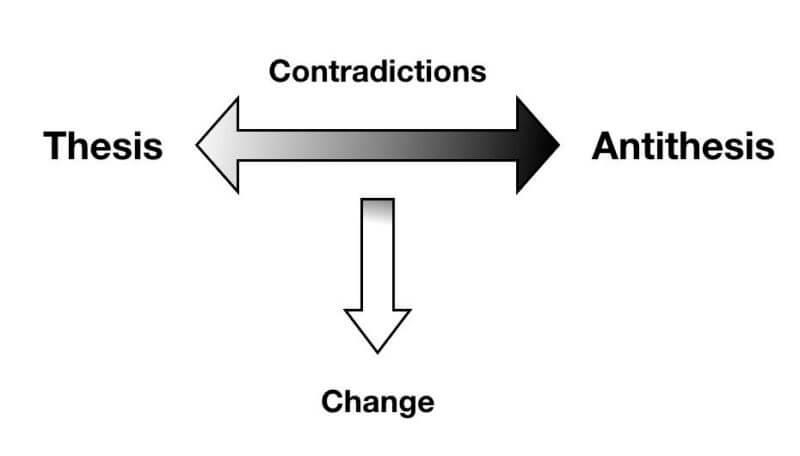
This has been the basic building block of storytelling since the first Greek plays were performed in the Theatre of Dionysus, at the beginning of the 5th century. The plays and storytelling were engineered around the logic flow of crisis and emotional journeys, and this process has carried over to modern times.
This is exactly what good branding does as well — it inspires action, change, aspiration, or in some cases, gets your customers to fix something that ails them or change their minds. When your brand is an awesome experience, it literally transforms your users!
If you don’t believe story matters, then you’re going to have a hard time creating the kind of message that evokes emotion and action. At the end of the day, all your brand has is one amazing story, broken into snackable bits and pieces, told over time, across various touchpoints and pain points. That’s it!
Creating the right message
Story matters, so to be successful in motivating consumers, you need to create the kind of message that evokes emotion and action.
Why do we do this? Because a well-told story is unforgettable, and it translates to people caring about your brand, which inspires loyalty and helps with recall. These are things no amount of tech or media can or will ever do.
Tech and media merely amplify those sentiments. If you don’t have this level of depth to your story, it will just be garbage in, garbage out.
Define your brand and its objective
Your brand’s objective is simply its purpose. Knowing why your brand exists, what purpose it has in the world and what it stands for is what defines it from the very start.
When you want to define your brand, you’ll need to ask yourself some questions:
- What problem does my brand solve?
- Who is my ideal customer?
- Who is my competition?
- What does my brand make my customers feel?
- Why do my customers trust me?
- What is the story behind why my brand was created?
- If my brand was a person, what would their personality be like?
Once you answer these questions, you can begin to choose things like logo colors and font, your motto or tagline and other marketing elements to communicate your brand’s overall story.
Let’s look at an example and put this into action.
Let’s say you have determined your brand’s ideal customers are young women getting ready to get married. Your competition includes high-end bridal companies with very elegant looks, but you are presenting yourself as more youthful.
You are trustworthy because you don’t sugarcoat the reality of expensive weddings. Instead, you help brides have their special day without going into debt. You have your story of why you created this brand, and if your brand was a person, she would be a young, thrifty bride who wants a beautiful day but has a practical head on her shoulders.
With all that in mind and knowing you are targeting younger brides, you can stay away from elegant and mature logo colors. Go with fresh, trendy bridal colors that are feminine and pretty. That’s how you translate your brand story into your marketing.
Here are three companies that have used brand strategy to succeed:
Dia
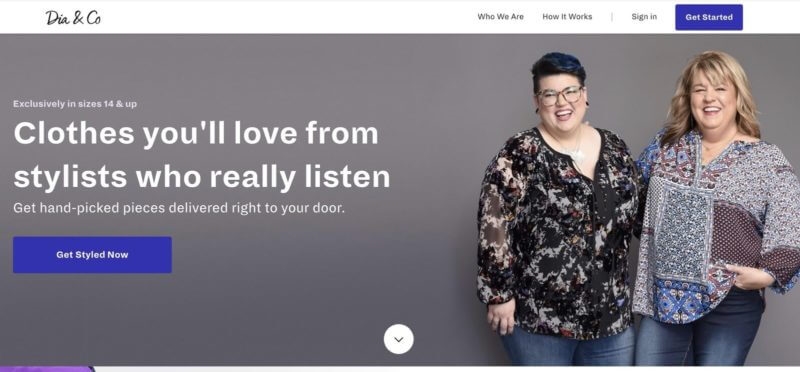
I think they have a great tagline, “Clothes you’ll love from stylists who really listen”.
Boom! It hits both the gain and the pain point in just one sentence. Sure, there is more to it, but if I’m a user, this helps me make a decision to continue or click away.
In a split-second, the mind resolves these questions:
- Am I a plus-size woman?
- Am I interested in clothing chosen by stylists?
- Will I be forced to work with salespeople who don’t understand my body type?
Probably a “yes” to all three questions if this is your target user.
Molekule
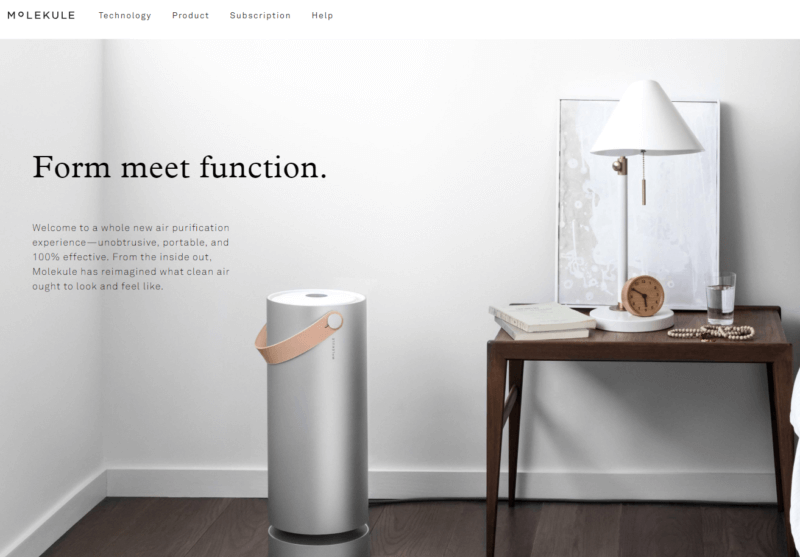
Molekule seems to understand modern marketing. This is website design done right.
On their site, in the first section, we see testimonial quotes from users and three testimonial videos around three customer pain points: asthma and allergies, mold allergies and multichemical sensitivity.
These three segments are defined with three accompanying case studies from real customers who experienced a difference using Molekule products. A user can feel a bit of catharsis when they see someone also suffering from these issues, sharing their story of how it made a difference. Molekule leads with emotion first, which is smart; starting with testimonials first makes sense for a new product in a competitive market
Hw competitive is this market? A simple search for their unique brand name shows Dyson is hot on their tail. A publicly traded brand (Dyson) is allocating ad spend on this small business’s brand name searches? That’s quite aggressive. Good job, Molekule!
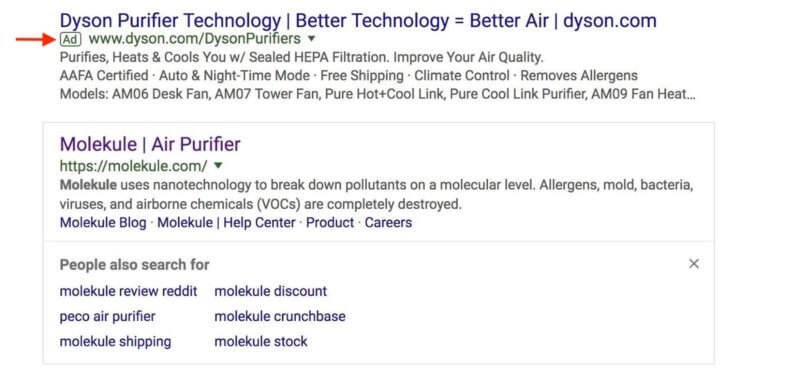
This is a great example of a quantitative insight that is gleaned from brand strategy.
On a different page of the Molekule website we see a proposition that defines them as an entirely new product category: “Meet Molekule, the world’s first molecular air purifier.”
Based on that statement, we can assume even Dyson doesn’t have a product like this. This is a new product in an existing space, and it’s not easy for a startup to launch and thrive. But if the product does what it says it does, it should do very well.
Ubiome

This is a very exciting area, one I am personally interested in and familiar with.
In my opinion, this site is nice but misses the mark in a couple of areas. Instead of user-centric language and story, the home page primarily focuses on the company. It says what they do, their vision, how it works, how they did it and discusses places where the company was featured. Those traits are great, and the information is important, but as a first time user, I don’t feel connected to the product.
I had to dig to finally find this information buried in body copy, halfway down a secondary page:
“Unlike carrier screening tests, which look at the health risks for a baby, the Fertilome test reveals genetic risk factors related to reproductive conditions that may affect a woman’s abilito conceive.”
Aha! Now a user knows “what’s in it for me.” This sentence could be refined into one powerful statement that hangs at the top of the website instead of being buried and captures the audience immediately.
Right now, what they have are several call-to-action (CTA) statements in a rotating slide:
“Bringing personalized medicine to fertility — The Fertilome test is the world’s first multi-gene genetic test for reproductive health.”
“Fast Company recognizes Celmatix — Named one of the world’s 50 most innovative companies.”
The statements focus on important accomplishments, but they don’t help me understand what they’re about. And more importantly, they don’t help me understand what the brand helps me do, fix or decide on.
Hiding in one of the three slides is something I missed the first time I went to the home page because the slides change so fast:
“Are you interested in learning what your genetics may reveal about your reproductive health & fertility potential?”
This is the only slide with text that hints at what I, the user, could get out of this brand.
Update: As I was writing this article, Ubiome updated their home page and incorporated a number of new things making it friendlier and more informative:

Zume Pizza
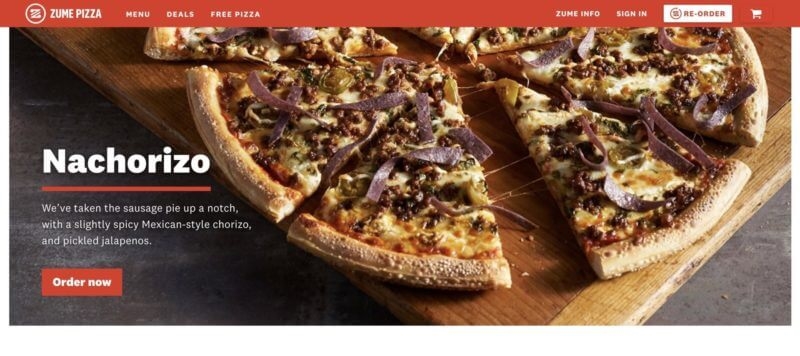
Zume Pizza has an interesting problem. It’s trying to balance volume transactions for returning customers with proper messaging for new customers. The company leads with daily offers which, unfortunately, makes them look like every other pizza website, so at first I’m greeted with action — not emotion.
This is OK, since your user base includes people who want to be able to come back and order once they’ve become a fan. But for the uninitiated, if you scroll down to learn more, you are met with solid value propositions:
“Fresh, local ingredients.” This is attractive to me.
Delivery reimagined as “food trucks with oven.” That sounds cool!
“Sustainable packaging.” That’s thoughtful.
“Automation done right” is the very last point, as it should be. I don’t care too much about internal operations, or how the pizza’s made, unless we’re talking about fire-ovens.
I still would like to see one or two of those values come out sooner at the top. In a high-volume e-commerce flow, it can be tough to find those brand vs. response tradeoffs. But it has to be done, and it all starts with a conversation with all shareholders involved. Then it has to be crafted and probably visualized in a way that holds both agendas in proper balance.
You can also consider a simple tech play: Only new customers see offers at the top of the page, and returning users see a custom page with value offers at the bottom. This might be a good idea if returning customers make up 30 percent or more of your traffic.
Vigilante
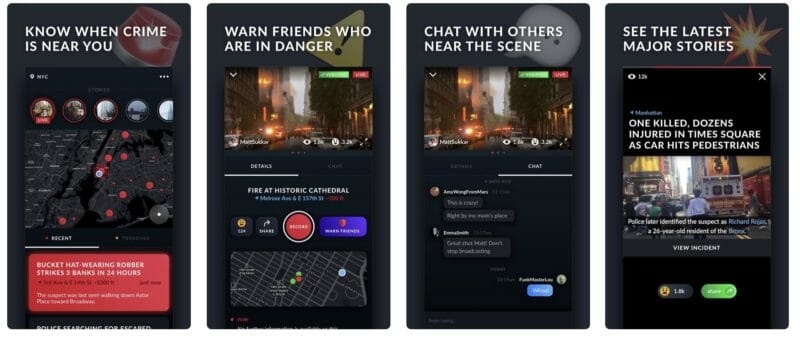
The Vigilante app has recently been rebranded as Citizen. It’s a good idea that has some issues, from what I can see, starting with its basic function. Here is a description of what the app does:
“Citizen is an app that shows 911 incidents in your neighborhood in realtime.”
After launch, they had to pivot their stance due to pushback. With the exception of dropping one feature, they changed their story, not the tech or design.
If you are a startup — or even an established brand that might have missed the mark on a product or service — be ready to revise and update your story, over and over if need be until you get the response you want. Getting your brand-response message right is going to pay dividends, far more than getting your timing or placements right.
Target market research
Once you understand your brand strategy, you may be ready to jump right into executing your marketing. But before you get started, there is another important step you need to do first: target market research.
Researching your market — and understanding who your audience really is and what will grab them emotionally — is a big part of executing your brand strategy correctly. There are some things you’ll need to do in your target market research, including creating a customer persona.
A customer persona is a detailed description of the ideal buyer who would not be able to resist buying your product or service. This persona helps you understand what type of person you are targeting with your marketing. You can’t have an emotional impact if you don’t know who it is you are trying to connect to.
Some questions to ask when creating your customer persona include:
- What demographics does this person fall into?
- Are they married with kids, what is their age, what is their gender, how old are they, etc.?
- What is their educational background?
- What career path are they on? Are they trying to get the top of the corporate ladder, or are they interested in being a small business owner?
- What is their current job, and in what industry?
- What does their typical day look like?
- What skills do they need to be successful in a typical day?
- What are their biggest daily challenges?
- How do they define success?
- Where do they get their news and information from?
- Where do they prefer to shop?
- What was their most recent purchase?
Understand the consumer journey
The next thing to understand about your ideal customer is where they are in the consumer journey. The consumer journey is a map that shows how a consumer is connecting with your brand at any given moment. It can range from “not connected at all” to “loyal brand advocate and repeat customer.”
Along the way are points like “interested in your product” or “interacting with you on social media” or “first-time buyer.” Understanding the consumer journey as it relates to your business will help you come up with a roadmap to move consumers along to the ultimate goal.
For example, if you find many of your consumers are dropping off the journey map after their first purchase and never returning to your store, you may need to consider creating a loyalty rewards program.
Where is your audience?
Finally, another very important thing with your market research is to know where your audience is, both physically and in the digital world.
You need to know where your target audience will be most likely to connect with you. Are you targeting online shoppers who primarily hang out on Instagram, or are you targeting people who want or need the experience of in-store shopping?
You also need to know where your audience physically lives because this can give you insight into your customers’ core values. If your target audience is made up of Californians who live in big cities, the way you market your products will be different than if your audience is primarily from rural towns in Missouri.
Knowing all of this is so important because it helps maintain cost efficiency in your marketing efforts. There’s no point fishing in the pond when all the fish are in the lake.
Here are the types of research you should include during this process:
- Focus groups.
- Surveys and questionnaires.
- Data synthesis.
Invest in creative brand guidelines
Once you understand your brand and your audience on a very deep level, it’s time to think about how you will deliver your message. This is where you’ll start to get creative with things like the logo design, the fonts you use on your website, the colors you choose to represent your brand, the general tone of your advertisements, the imagery you use and so on.
These elements are very important for creating a long-term recognizable brand. Once people have connected to your brand, they’re no longer considering your values because they know them. Now they are just recognizing your brand’s colors and logo and font and instantly adding you to their basket. So you need to ensure that these elements are chosen carefully and that they truly relate to your message.
Brands do evolve over time, but it’s important to set the creative guidelines before marketing execution. This allows you to ensure that even in the future, your branding will match your story.
Competitive analysis
Another thing that brands need to research before executing marketing strategy is the competition.
Competitive analysis is extremely important because it helps you understand what specifically differentiates you from the competition, and that is something you’ll want to focus on in your marketing message.
If you attempt to execute your marketing first, you may end up saying the same thing as every other company out there, which doesn’t inspire the customer to shop from you over them.
Questions to ask before launch or execution
These are seven questions every marketer should ask themselves about their brand before execution:
- What makes our brand different? You must understand what makes you unique so that you can highlight why customers should choose you over the competition.
- Is our brand a lifestyle? You need to understand how your brand fits into your customers’ lives. Understanding how your brand is a “lifestyle” will help you acquire customers in specific parts of their consumer journey.
- Why does our brand exist? You must be able to boil everything about your brand down to a single purpose or problem to solve, in order to focus your marketing.
- Who are we talking to? You need to know who your message is for in order to know how to connect with them emotionally.
- How do we talk to them? The next thing you need to know is how your brand communicates. This includes everything from how you use social media to the tone of your marketing messages. This is the outward expression of your brand’s purpose, and it will give the customers their first impression of who you are.
- Where are our time and money best invested? You need to know what marketing channels are the best for you, based on where your audience is and how they prefer to connect with you.
- What is our brand story? Finally, remember that story is everything in marketing. You must be able to tell a story from the beginning to the end that shows how your brand changes something for the consumer along the way.
Why some brands fail
The top five reasons some brands often fail at their brand strategy are:
- Lack of long-term vision.
- Not solidifying the brand identity and message.
- Inconsistent creative.
- Not understanding their ideal customer.
- Product-to-market fit that is now outdated or never hit the mark.
Branding has to do with focusing your vision on an experience.
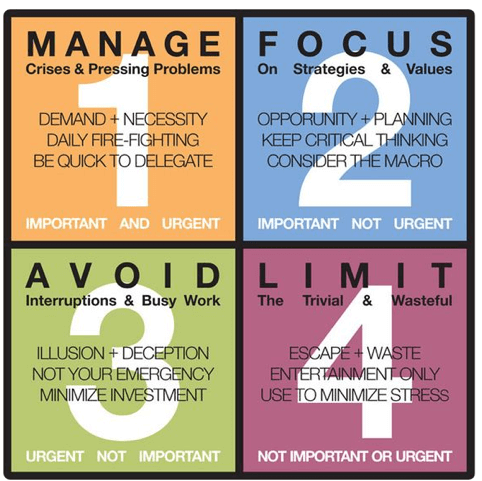
One problem I see often is when corporations force the use of management workflows designed for analytical procedures into the creative work. Creative work should be built from “strategy frameworks,” which requires a completely different process.
Summary
The most important takeaways about brand strategy in 2018 are:
- You need to research and understand your customer.
- You must know what your brand stands for, and what your brand’s story is.
- You must build your marketing techniques from the first two things before you ever begin executing marketing campaigns.
It’s that easy and that complex. Take the time to do this right from the beginning, and you will have a much more successful marketing strategy.
Opinions expressed in this article are those of the guest author and not necessarily Marketing Land. Staff authors are listed here.
About The Author

Producer and Creative Director Allen Martinez founded Noble Digital agency and has been creating creative branding and performance campaigns for B2B and B2C startups like: Plated, Fundrise, Telesign as well as corporations such as: Coca-Cola, In-Bev, Subway, Nestle, AT&T, Anheuser-Busch, Quest, Hilton Hotels, Burger King, Univision, Yamaha, Miller Lite, Proctor & Gamble, McDonald’s, Heineken, Orbitz, Wrigley’s and many others. Martinez has used Noble Digital as a platform to implement what he has learned through helping Fortune 500s by reverse-engineering these powerful tools to launch and scale funded startups as powerfully as established corporations.
Marketing Land – Internet Marketing News, Strategies & Tips
(72)