
This approach focuses on GTM alignment, including shared goals, clear roles, collaborative communication and unified metrics.

Here’s a statistic everyone needs to know: 76% of marketers achieve higher ROI with account-based approaches than other marketing strategies, per the ABM Leadership Alliance and ITSMA. Yet, many organizations still struggle to unlock this potential, especially when it comes to expansion revenue.
Why? The answer often lies in how teams implement the strategy, not the strategy itself. The difference between moderate and exceptional results usually comes down to one critical factor: cross-functional alignment.
In my last article on account-based expansion (ABE), I introduced the the 40/40/20 rule; now, I’ll outline a framework for GTM alignment.
The hidden cost of misalignment
New logo acquisition costs have doubled recently, and expansion opportunities within existing accounts are often not prioritized. The reason? Siloed operations and fragmented approaches to customer growth.
Most organizations today operate with marketing chasing MQLs, sales pursuing new logos and customer success focusing solely on retention. This traditional structure made sense in simpler times, but in today’s complex B2B environment, it’s leaving revenue and customer growth on the table.
The ABE alignment framework: A four-pillar approach
Here are the four critical pillars for effective cross-functional alignment.
1. Shared vision and goals
The first mistake most organizations make is jumping into tactics without establishing a unified vision. Effective ABE alignment starts with:
- A clear charter that defines what success looks like across all revenue functions.
- Specific, measurable objectives that cascade from business goals to team-level KPIs.
- Shared metrics that encourage collaboration rather than competition.
For example, instead of marketing owning MQLs, sales owning opportunities and CS owning retention, successful organizations create shared metrics like “expansion-qualified accounts” that require input and collaboration from all teams.
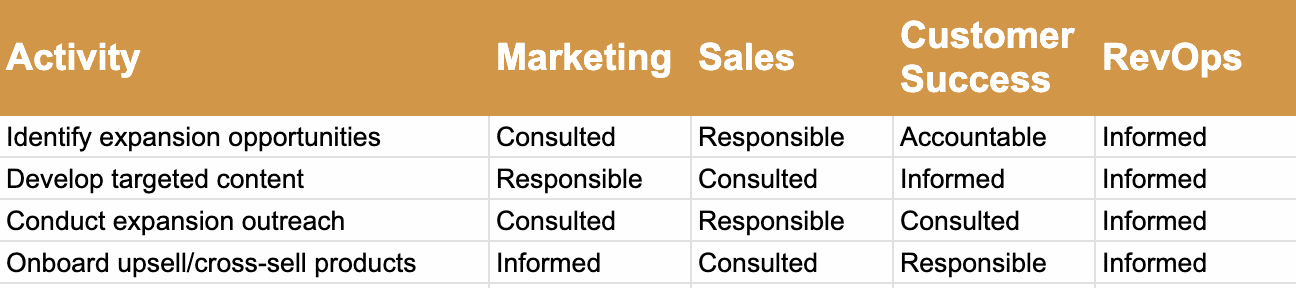
2. Defined roles and responsibilities (RACI matrix)
Clear ownership prevents the “not my job” problem while ensuring nothing falls through the cracks. Here’s how to structure it.
3. Streamlined communication and collaboration
Effective ABE requires real-time information flow and coordinated action. Essential elements include:
- Weekly ABE team syncs focused on account strategy and execution.
- Shared chat channels for real-time collaboration.
- Monthly executive reviews to address strategic challenges.
- Quarterly business reviews to assess progress and adjust course.
4. Shared metrics and reporting
You get what you measure. Successful ABE programs typically track:
- Account health score (combining product usage, engagement and satisfaction metrics).
- Expansion qualified account (EQA) conversion rates.
- Average deal cycle.
- Net revenue retention.
- Customer lifetime value.
The key is creating a single source of truth that all teams trust and use to make decisions.
Overcoming common alignment challenges
Even with the right framework, implementing cross-functional alignment isn’t easy. Here are the most common challenges and how to address them.
Siloed organizational structures
- Create cross-functional ABE pods.
- Implement shared OKRs.
- Regular cross-team training and knowledge sharing.
Conflicting incentives
- Align compensation models across teams.
- Create shared success metrics.
- Implement team-based rewards for expansion wins.
Lack of trust between teams
- Regular joint planning sessions.
- Shared account reviews.
- Celebration of collective wins.
Resistance to change
- Start with pilot programs.
- Document and share early wins.
- Provide clear career paths in the new model.
Looking ahead: The future of ABE alignment
The future belongs to organizations that can break down traditional silos and create truly integrated revenue teams. As customer acquisition costs continue to rise, efficiently expanding existing accounts will become an increasingly critical competitive advantage.
The question isn’t whether to align your teams around ABE but how quickly you can make it happen. Those who move first will have a significant advantage in building the muscle memory and processes needed for successful expansion motions.
To make it happen, start small and:
- Pick your top 20% of accounts.
- Create a pilot ABE team.
- Implement the four-pillar framework.
- Measure, learn and adjust.
- Scale what works.
Remember: Alignment isn’t a one-time exercise. It’s an ongoing process that requires constant attention and refinement. But get it right, and you’ll unlock new levels of growth that will have your CEO and board asking how to invest more.
The most successful B2B companies of tomorrow won’t be the ones with the biggest acquisition budgets. They’ll be the ones who master the art and science of efficient acquisition-to-expansion execution with aligned revenue teams.
The post Break down silos with a 4-pillar foundation for account-based expansion alignment appeared first on MarTech.
About the author

Steve is currently the CEO & founder at twelfth, a boutique marketing agency that specializes in GTM growth and demand generation. Prior to founding twelfth, Steve held several marketing leadership positions in the B2B SaaS industry including Google Cloud, Workspace, Chrome, and Android. Steve is a keynote speaker, frequent podcast guest, and thought leader on the topics of account-based strategies, GTM, demand generation, growth marketing, and operations.
(13)