Vivek Ramaswamy spent $3.3 million to buy 8% of BuzzFeed. How much damage could he do with that stake?
It may be a small fraction of the company, but activist investors in Apple and ExxonMobil have accomplished a lot, with a lot less.
BY Clint Rainey
Update, 5/23/24:
After this article was published, BuzzFeed reached out to clarify that Ramaswamy didn’t notify anyone, from the C-suite down, that he was hoovering up shares. He started buying BZFD back in March, but the company only became aware of this on Wednesday, at the same time as everybody else. A spokesperson said this threw the leadership team off so much that they were double-checking their inbox spam folders to ensure nobody missed an email—such requests are a common courtesy paid by activist investors, who also tend to see the element of surprise as something to avoid if the goal is real change.
Also, BuzzFeed told Fast Company that under its dual-class stock structure, class B shares—the type that company leaders hold—are more coveted, conferring 50 times the voting power compared to the class A shares that Ramaswamy holds. You’d need just 66,000 class B shares to cancel out his newly acquired vote; BuzzFeed co-founder and CEO Jonah Peretti currently possess 5.2 million, giving him 64% control over the company. BuzzFeed believes Ramaswamy still bought enough shares to qualify as the seventh or eighth largest overall shareholder—a force, to be sure, but one that can be checked by not just established media that can outvote him, but also the people who built the BuzzFeed brand.
In other words, the path Ramaswamy is following so far to achieve a potential “shift in the company’s strategy” is not a strategy endorsed by successful investors, and, according to BuzzFeed, his target is a public company purposefully structured to protect its editorial integrity in the event that an investor who is a poor fit suddenly gets any crazy ideas.
Original story:
Wall Street has countless stories of investors acquiring stakes in companies for which they seem like very bad fits—Bill Gates investing in Waste Management, America’s leading garbage company; Warren Buffett getting into American Airlines, Delta, United, and Southwest a few years after calling the airline business a “death trap.” Yet Republican high-haired former presidential hopeful-turned-Trump campaigner Vivek Ramaswamy jumping into bed with left-leaning, listicle-heavy BuzzFeed is still likely to cause a double take.
A disclosure form that was submitted to the SEC this week by Ramaswamy reveals that the former hedge fund manager is optimistic about the future of the media company that pioneered clickbait, then got more serious and established BuzzFeed News; won some Pulitzer prizes; misgauged the market’s appetite for investing in digital journalism; mounted a poorly received stock debut in 2021 via a SPAC; laid off the award-winning news division; and ended up trading for as little as 71 cents per share.
But according to the filing, Ramaswamy believes BuzzFeed’s shares “represent an attractive investment opportunity,” which is why the talk show and podcast staple—estimated to be worth $1 billion by Forbes, off fortunes made in biotech and in finance via the “anti-woke” investment fund he founded—has acquired a minority stake. The disclosure states he now owns around 8% of BuzzFeed’s class A shares, catapulting him into position as that group’s fourth-largest shareholder. Ramaswamy acquired his sizable chunk for a lowly $3.3 million, the filing says. A steal, if you believe the stock is undervalued.
He hasn’t commented yet on his plans, other than to tell CNBC cryptically through a spokesperson: “Stay tuned.” But the filing notes for now that he intends to do things the usual way, and “engage in a dialogue with board or management about numerous operational and strategic opportunities to maximize shareholder value, including a shift in the company’s strategy.”
What comes after “including” may strike a chord with progressive critics, plus any remnant of OG BuzzFeed fans, since Ramaswamy’s claim to entrepreneurial fame has been attempting to innovate “not woke” versions of mainstream products—everything from nonfiction books and ETFs to Nikes and Cokes.
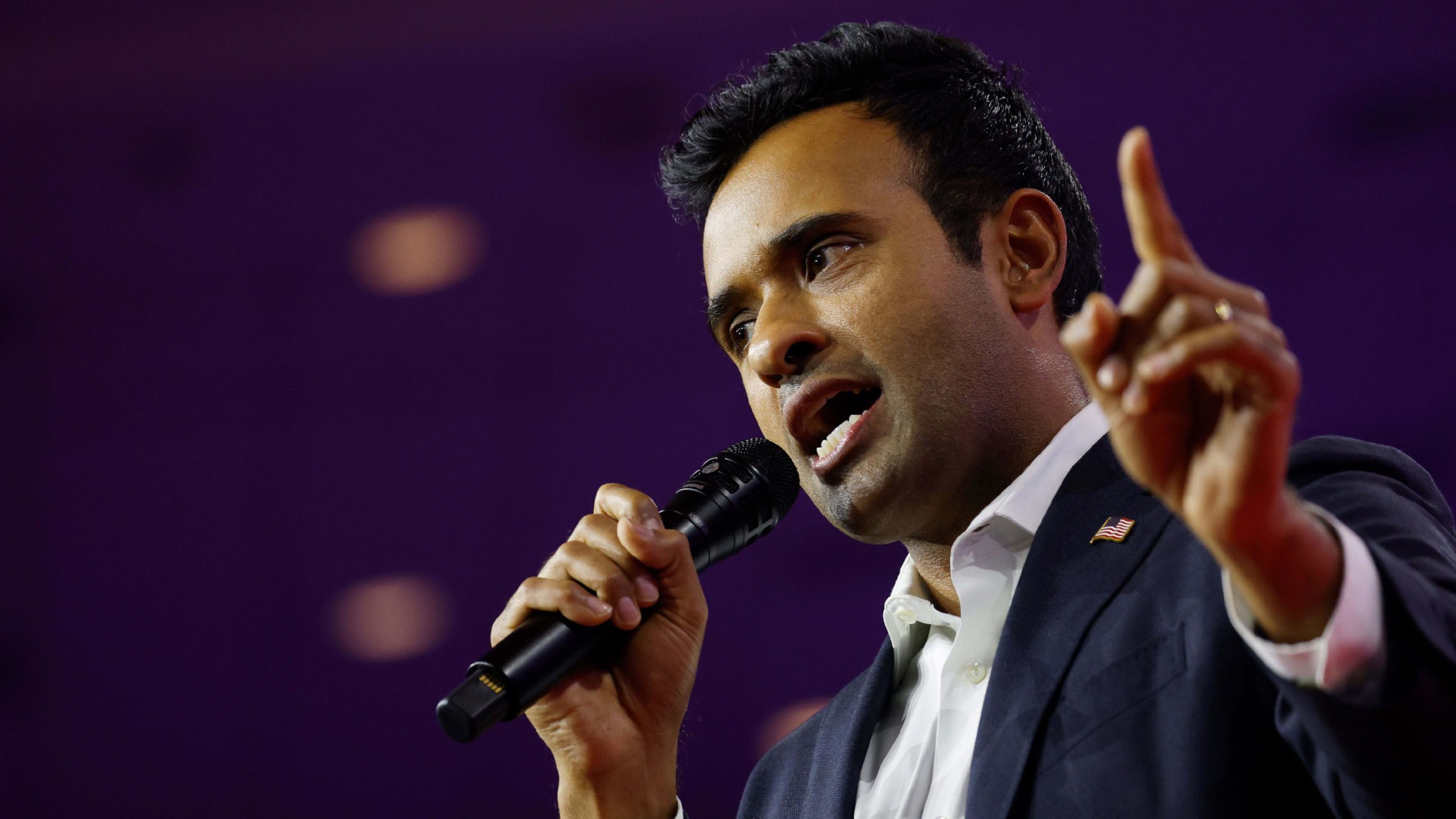
But even if he wanted to, the burning question is, could Ramaswamy remake BuzzFeed into a Daily Wire analog that cranks out quizzes like, “How woke are you? Take our test”? Or resurrect the hard-hitting news team, only this time staff it with the likes of Christopher Rufo and Alex Jones, conservative media fixtures with whom Ramaswamy pals around? The answer depends on a lot, but the shortest one is, possibly, yes.
To start with, activist investors have made plenty of major operational changes with smaller stakes. In 2013, Carl Icahn used a tiny investment in Apple (a roughly 0.25% stake) to rewire how the tech giant compensated shareholders post-Steve Jobs, through a massive stock buyback program and increased annual dividends that returned billions back to investors. Corporate raider Nelson Peltz, who “hates” that term because he argues his changes are so sweeping, has used stakes of less than 2% of companies like Procter & Gamble and General Electric essentially to reinvent them, appearing in board rooms with what’s described as “a ‘white paper,’ a thick deck of charts, and numbers about changes he would like to see made.” Companies that didn’t listen have found themselves picked apart and shrunken. And of course, Elon Musk leveraged an initial 9.2% stake in Twitter into a full buyout of the company, taking it private, then laying off 80% of the staff and letting bots and Nazis take over the platform.
Ramaswamy’s investment firm Strive used to bill itself as a less ESG- and DEI-friendly alternative to BlackRock, the world’s largest asset manager. It’s since “diversified” beyond that very limiting pigeonhole, on its way to crossing the $1 billion mark for assets under management. But meanwhile along the way, where it has focused a considerable amount of energy is on the shareholder proxy war side, trying to make changes to companies it invests in. Legally, public companies have to give shareholders a say in management; this means if you own even just a few shares, you can become a shareholder activist and push proposals that refocus corporate priorities. For this crucial component of Strive’s business, it hired Justin Danhoff, a pioneer of the practice on the American right. Danhoff made a name for himself by introducing resolutions prioritizing religious freedom, supporting the Second Amendment, opposing abortion, and basing fewer corporate decisions around racial and gender diversity.
Ironically, the best recent example of an activist investor winning big is one that conservatives bemoaned the minute it happened back in 2021. A small impact-focused investment outfit called Engine No. 1 purchased about 0.02% of oil giant Exxon Mobil; then, through a hard-fought proxy battle and a crucial alliance formed with fellow shareholders who believed a pivot toward energy transition was necessary, Engine No. 1 replaced three Exxon board members, triggering a flood of news article headlines like “Exxon’s board defeat signals the rise of social-good activists.”
Unfortunately for Ramaswamy’s current situation, Engine No. 1’s success hinged on help from Exxon’s three largest shareholders—the very trio whose grip on the financial world he started Strive to counter: BlackRock, State Street, and Vanguard, which at the time owned almost 20% of Exxon.
The three shareholders who own more of BuzzFeed than Ramaswamy are Comcast, the VC fund New Enterprise Associates, and the media company Hearst Communications. Asking them to buy into a BuzzFeed specializing in listicles like “Ten Truths” and “The 15 worst shirtless Hunter Biden pics” might get Ramaswamy a few LOLs and WTFs.
Correction: A previous version of this story misstated that the SEC disclosure form was filed by BuzzFeed. It was in fact filed by Ramaswamy.
Correction: A previous version of this story misstated that the purchase made Ramaswamy the fourth-largest shareholder of BuzzFeed. The story has been updated to clarify that he is the fourth-largest shareholder of BuzzFeed’s class A shares.
ABOUT THE AUTHOR
(20)