
AI is breaking the old playbook for brand discovery, and most B2B CMOs admit they’re not ready for what comes next.

Two-thirds of CMOs say they lack the skills, budget or resources to compete against faster-moving, AI-enabled challengers, according to new research from the agency 3Thinkrs.
That’s because the acceleration of AI-generated search and decision-making is rapidly eroding traditional marketing levers. With brand visibility collapsing across search, websites and social, the race is on to modernize strategies for the new era of AI-first discovery.
The findings come from “A CMO’s Marketing and Communications Playbook for 2026,” a survey of 400 B2B tech marketing leaders — and they paint a picture of a playbook that’s falling apart faster than many teams expected.
Traditional channels are slipping as AI grows
According to the report, B2B tech websites experienced a 34% decline in traffic between 2024 and 2025, despite AI-generated traffic accelerating toward an expected 20% share by the end of 2025. That is a significant erosion of the traditional content ladder that marketers have depended on for decades.
Search is changing, too. The study projects that by 2027, traditional search will account for just 45% of all search queries, a 42% drop from earlier norms. Social media channels are also feeling the impact. On LinkedIn, the visibility of organic company content has slipped sharply — from 2.1% to 1.6% of users’ feeds between March and October 2025 — shrinking the reach of content that once drove awareness and engagement.
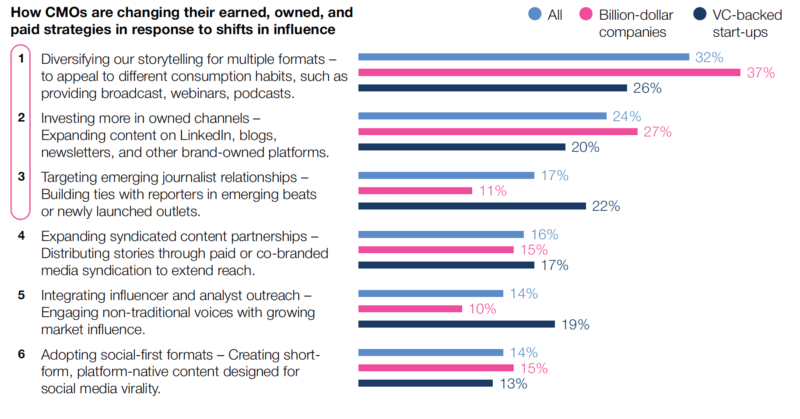
With generative engines replacing traditional search behavior, CMOs are being forced to pivot. Generative Engine Optimization (GEO) is now the must-have capability for teams trying to stay visible in zero-click environments.
Sixty-one percent of marketing leaders are already adapting their strategies to improve visibility in AI-generated summaries and answer engines. The shift is moving marketing from keyword placement to “confidence signaling” — ensuring that AI models recognize your brand as credible, current and authoritative.
That means:
- Reformatting content into AI-friendly structures — with listicles alone making up nearly a third of cited results.
- Keeping content fresh — AI tends to deprioritize material more than one to two months old.
- Investing in PR — especially for startups. Forty-five percent of VC-backed brands plan to increase PR budgets to improve presence in trusted sources like Bloomberg, Fortune and Forbes.
- Tracking new metrics — like AI visibility scores, citation share and “share of AI voice” (the most-used share-of-voice metric reported to CEOs, at 33%).
Message fragmentation is the hidden risk
As generative search tools synthesize responses from across the web, brands that lack a clear, unified narrative risk being misrepresented — or ignored altogether.
And that’s a real problem: 61% of CMOs say their company is only “mildly proficient” or worse at maintaining a shared brand story across PR, content and sales. Without a strong narrative, even great content may fail to earn visibility.
Marketers are responding by leaning into structured storytelling: think contrast-based messaging (problem/solution), the rule of three, or clear hero/villain arcs. Repetition and rhythm — across every channel — are becoming key to driving recall and reinforcing trust.
CMOs are also doubling down on more engaging formats. With LinkedIn organic reach declining, 54% say they’re prioritizing short-form video and multimedia content as a way to reclaim relevance.
Deepfakes are rising and B2B brands aren’t prepared
While most of the focus has been on visibility, AI has also introduced a whole new category of reputational risk: synthetic media.
Generative AI makes it easy to produce realistic — but fake — video and audio content. Despite the threat, only 16% of B2B tech brands have a general crisis communications playbook, and just 14% have a specific response plan for AI-generated threats like deepfakes.
What’s worse, 26% of CMOs say they’d rely solely on their internal teams to handle such a crisis — even while acknowledging the lack of formal procedures. That leaves most brands dangerously exposed in a landscape where misinformation spreads fast and credibility is everything.
The post 62% of B2B CMOs not ready to compete against AI-enabled companies: report appeared first on MarTech.
(1)