
Employee ownership isn’t an exit plan—it’s a legacy
Shared ownership can sustain a company beyond any one leader.
Steven McKay
span>span]:whitespace-nowrap”>
What if, instead of working toward an exit strategy, we built companies for longevity?
That’s
the question at the heart of employee ownership. It’s not just a perk
to lure talent. It’s a fundamentally different way of building a
business, and one that might just be the key to long-term resilience.
I’ve
spent nearly my entire career inside a 100% employee-owned
architecture, engineering, planning, and interiors design firm. Today as
CEO, I lead its 1,800 employee-owners. I’ve seen firsthand how this
model changes everything, from how team members treat clients to how the
organization is able to weather change. But this isn’t a story about
just one company. It’s about a mindset shift that could help more
companies build lasting value instead of just quick wins.
RETHINK OWNERSHIP: BEYOND THE CAP TABLE
When
most people think of ownership, they picture equity grants or stock
options. But real employee ownership is more than a line item. It’s a
structure that changes incentives, yes, but also culture, leadership,
and accountability.
Being
100% employee-owned has shaped how we make decisions, collaborate, and
deliver work. When you know your colleagues have skin in the game, you
trust them differently. You lead differently. You take responsibility in
a way that doesn’t hinge on hierarchy—it stems from care rooted in real
ownership.
And when your clients know they’re dealing with
employee-owners, not just employees, that builds trust in return.
Clients can feel the difference. It’s not always easy to define, but
it’s palpable—in the commitment, the deep sense of shared
responsibility, the pride people take in the outcome.
WHY IT’S SUSTAINABLE—AND SCALABLE
One
of the most compelling reasons to explore employee ownership is its
long-term viability. When a company is built around shared
responsibility instead of individual power, it becomes more resilient to
leadership changes. I once spoke to a CEO who said he wasn’t sure his
company would survive without him and his fellow majority owners. I
can’t imagine building something without knowing that it would endure
for future generations.
The
company’s legacy shouldn’t rest on any single person. Our founding
partners built the company on the idea that if you invest in the
company, the company should invest in you. That spirit helped guide our
transition to full employee ownership decades ago.
Shared
ownership encourages leaders to think beyond the present moment. In my
experience, it also invites more people into that conversation. When
ownership is broad-based, strategic planning becomes a collective
effort, not just a top-down mandate. Teams are more likely to align on
long-term goals, and more willing to adapt when circumstances change,
because they’ve helped shape the direction.
Ownership changes the
timeline you’re working on. You stop optimizing for the quarter and
start asking bigger questions: What will serve our team, our clients,
and our communities for the next 5, 10, 15, or even 50 years?

INNOVATION THROUGH INCLUSION
One
possibly unexpected benefit of employee ownership is what it unlocks
creatively. When people feel a genuine sense of agency, they collaborate
differently. Our firm uses a matrix leadership model that gives
different types of experts the chance to lead depending on the problem
at hand. That level of collaboration always brings its own challenges,
but more importantly, it creates room for new ideas and
cross-disciplinary solutions to emerge.
Ownership doesn’t just
empower decision making; it encourages experimentation. We support
things like personal development grants that allow employee-owners to
pursue research projects outside their day-to-day work. One grant led to
a neuroinclusive design exhibit
featured at a major international architectural showcase. These kinds
of initiatives don’t just enrich culture—they advance innovation.
WHAT LEADERS SHOULD ASK THEMSELVES
Employee
ownership isn’t right for every company. But it’s a model worth serious
consideration, especially for leaders thinking about employee
engagement, long-term value creation, or succession.
If
you’re a founder or executive, ask yourself: What will happen to your
company when you step away? Will the culture, vision, and value you’ve
built live on? Or does everything rest on the shoulders of a few people
at the top?
Ownership changes that equation. It puts real sustainability at the core of how a business operates.
I’ve seen what happens when people aren’t just asked to think like owners, but actually are
owners. It creates a different kind of business: one that’s more
resilient and more invested in the long term. In a world full of
companies built for the exit, we need more that are built to last.
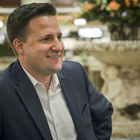
Steven McKay is the chief executive officer of DLR Group.
(12)