
 Stefan Palios February 14, 2021
Through the COVID-19 pandemic pushing the world into chaos, freelancing has emerged in a new way. More people than ever are considering freelancing and many are freelancing in addition to a full-time job.
But what if freelancers and gig workers made up their own country? Freelancing has been happening for literal centuries, but mainly in the shadows. What about a hypothetical scenario where every freelancer lived in one country, and the entire economy was powered by freelance work?
Let’s crunch some numbers.
The factors that most people want to know about a country are:
- Population
- Earnings or “GDP”
- Earnings per person or “GDP per capita”
- Overall employment rates
- Education
- Citizen happiness
Comparing freelancers to the world’s largest countries
There are an estimated 162 million ‘independent’ workers in the US and Europe along, according to McKinsey. If you add in the millions more throughout Canada and Southeast Asia, you can reasonably estimate there are ~200 million freelancers globally – at least.
At 200 million freelancers globally, that puts “Country of Freelancers” as the 8th largest country in the world.
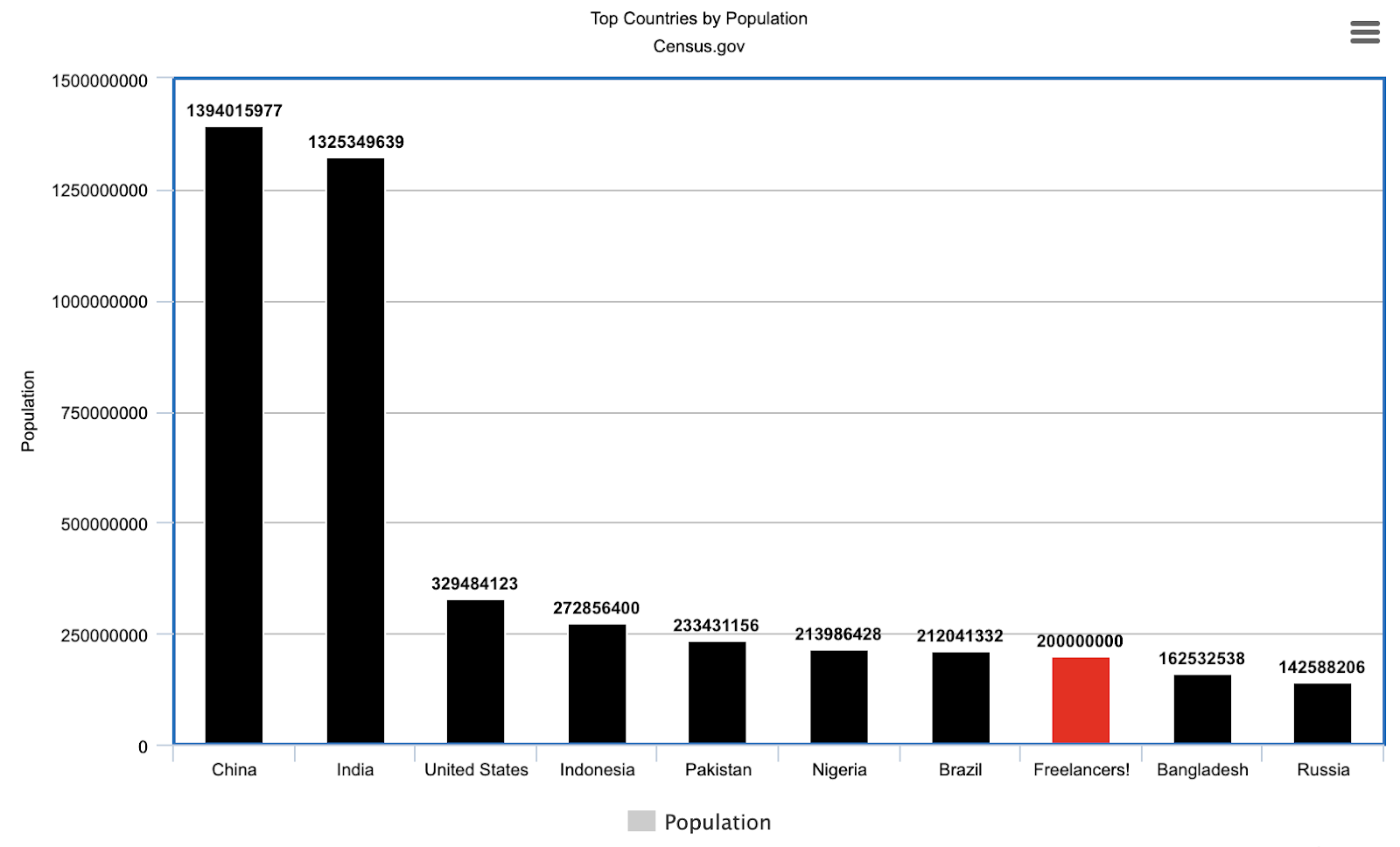
If freelancers were a country, they would push Mexico out of the top 10 countries by population.
Earnings / GDP
Freelancers contributed $ 1.2 trillion in value to the US economy alone. The US represents around one quarter of global freelancers (around 57 million freelancers in the US and about 200 million globally, based on our estimations).
So with that extrapolation, the global freelance economy is worth around $ 4.2 trillion.
With a “GDP” of $ 4.2 trillion, freelancers make up the fourth largest economy in the world, right behind the United States ($ 21.4T), China ($ 14.3T), and Japan ($ 5.1T) according to World Bank data. Freelancers edge out Germany ($ 3.8T) for the fourth spot.
GDP per capita
GDP per capita – how much everyone is producing – matters a lot. For instance, the US is not even double the size of China by GDP alone. However, in GDP per capita it is about 7x more effective and efficient.
Taking a nominal GDP per capita approach (which is just GDP divided by population), freelancers have a GDP per capita of $ 21,000 annually. This roughly tracks with a study that found freelancers earn $ 21 per hour on average. While $ 21 per hour annualizes to over $ 40,000 in salary, freelancers aren’t always working 8 hour days or 40 hour weeks.
While freelancers might make up the eighth largest country by population and fourth largest economy, individual earnings are low. Ranked on GDP per capita, freelancers come 43rd, according to nominal GDP data from Statistics Times. A country of freelancers would bump Lithuania down to the 44th spot and sit right behind Portugal in the 41st spot and Aruba in 42nd.
Employment for freelancers
There is no official “employment” rate for freelancers. Further, not all freelancers are the same. A freelance web developer, for instance, is likely to always find work. That isn’t the same in every case, for example freelancers who work in museums saw dramatic drops in income.
COVID also messed up employment numbers for freelancers. On one hand, freelancing is surging in growth and popularity. On the other, hiring numbers aren’t evenly distributed.
So while it’s impossible to estimate employment percentages for freelancers, there are indicators that freelancers can find work if they want to, given the proliferation of freelance marketplaces and managed services.
Education levels among freelancers
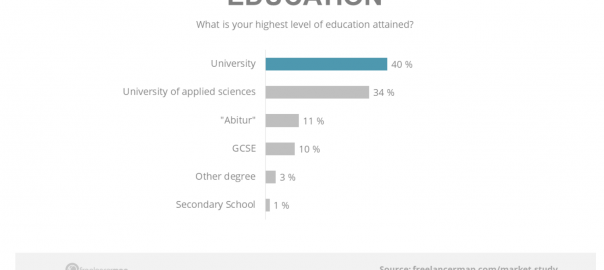
Freelancers tend to be highly educated. A study by FreelancerMap found 40% of freelancers completed a university degree. This is only slightly lower than the 44.9% OECD average.
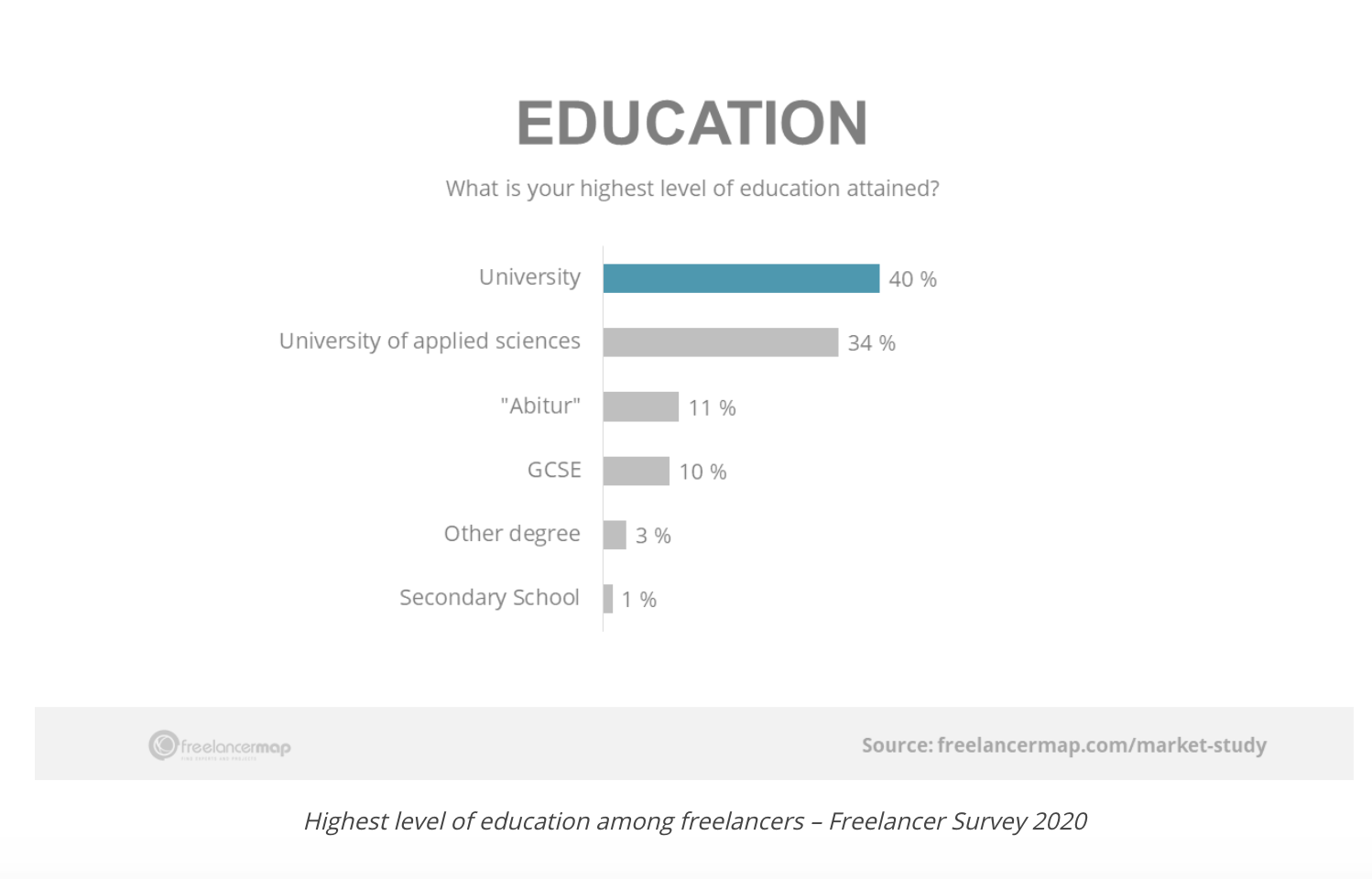 Source: FreelancerMap
However, 34% of respondents went to a university of “applied sciences,” or what some countries might call community college or technical college. Adding that to the mix shows that freelancers are well-educated, even if they aren’t quite as credentialed as the OECD average.
Happiness levels among freelancers
The annual rankings of the happiest countries in the world is big news. People are curious what it takes to build a ‘happy’ country. It seems freelancers have largely figured this out.
A major study found that freelancers typically like their work more than full-time employees. Further, freelancers often cite freedom and control over their day as major benefits of freelancing. Like any job, freelancing has challenges. However, it seems the benefits outweigh the challenges for most freelancers.
The freelance economy is booming
Since COVID started, a new light has shone on freelancers. Indicators suggest that freelancing will become the dominant way of work in the future. While this presents its own challenges, such as gig worker rights or a freelancer minimum wage, countries around the world are stepping up and paying attention.
In the meantime, freelancers are continuing to do their thing, whether that’s taking gigs from a marketplace or working with a small handful of ongoing clients.
Business & Finance Articles on Business 2 Community
(30)