
How Sun Day turned its logo into a protest sign
The logo for the new day of climate action features half a sun—the rest is up to you.
Hunter Schwarz
span>span]:whitespace-nowrap”>
Earth Day is getting a sequel—and it comes with an unusually engaging logo.
Founded by environmentalist Bill McKibben and Earth Day founder Denis Hayes, Sun Day
is a global day of action that will be held this Sunday, September 21.
The iconography of the first Earth Day was “fascinating,” says McKibben.
“There were a lot of things people were protesting against—you know,
oil spills off Santa Barbara, the Cuyahoga River catching on fire.”
The
most important design element, though, “was the picture that had come
back from Apollo 8 about a year before, the first vision of the Earth as
seen from space, and this fragile, blue-white marble in the black void,
arguably the most important photograph ever taken,” McKibben tells Fast Company.
How do you compete with that?
For
Sun Day, McKibben wanted to do something perhaps less iconic but
equally impactful: Thus, the logo is unfinished and invites us all to
fill in the rest.
A participatory logo

Before it was called Sun Day, McKibben says he had the idea for “Sky Day.” After turning to the team at the consultancy Collins, the realization was that there was no good way to draw a picture of the sky, but everybody was drawing the sun.
“In
this case, the design element is the sun, which is, if you think about
it, literally the one object on the planet you can’t look at,” he says.
The
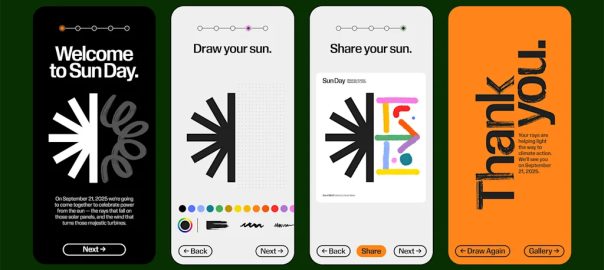
resulting logo represents only half the sun, with an asterisk-style
mark on the left side and a blank space on the right for people to fill
in their own drawing. As a symbol, the sun is simple and easily
abstracted; as a work of advocacy, it gives people a first thing to do.
It’s participatory by design.
“The basic message becomes we have
half of what we need, we now have the technology. We live on a planet
where the cheapest way to make power is to point a sheet of glass at the
sun,” McKibben says, noting that what’s lacking is the political will
to make clean energy work.
Collins created the branding for Sun Day with Commercial Type, which designed a custom Sun Day typeface that comes in print, brush, and outline weights. Garden3d built an application that lets users make their own sun drawings directly in the browser with MS Paint-like ease.
The
resulting brand is one that’s meant to look more DIY than
professionally designed. Already about 10,000 people have made their own
logos, including Jane Fonda, who drew a heart while in the rainforest
of Ecuador doing advocacy work.
“So many of these protests . . .
when really well-meaning designers get involved, they end up looking
like national design conferences instead of something where people make
shit,” designer Brian Collins says. “I think part of what people need to
see is their own voice in these things, whether it’s their children
. . . their parents, their aunts, their friends. What’s important is
giving people a voice to participate collectively.”
This isn’t climate activism as visualized through sad polar bears on ice caps or images of a cause that’s lost and a planet that’s too far gone. It’s optimistic—and something everyone can latch on to.
As Collins sees it, “Hope is a strategy, and hope is our strategy here.”
ABOUT THE AUTHOR
(10)